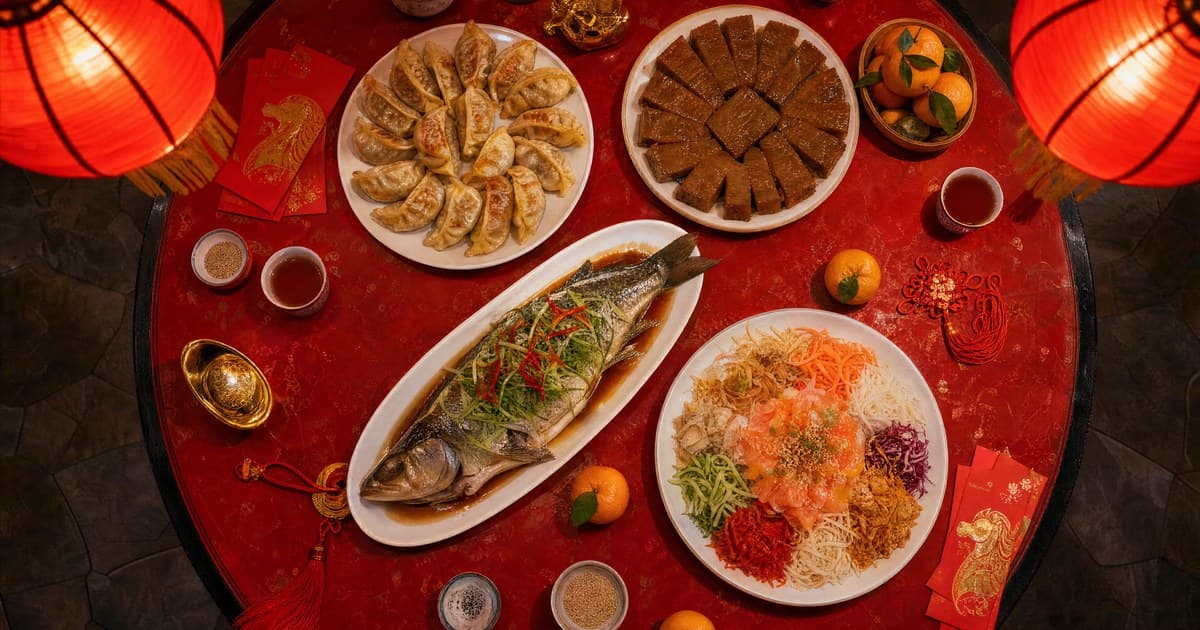
Chinese New Year / Spring Festival
春節/春节
About Chinese New Year / Spring Festival
Chinese New Year, known in Mandarin as 春节 (Chūnjié, "Spring Festival"), is the most important holiday in the Chinese cultural calendar, observed across the global Chinese diaspora over a 16-day arc beginning on the new moon of the lunisolar year and culminating with the Lantern Festival. The reunion dinner on New Year's Eve (除夕年夜饭, Chúxī Niányèfàn) is the spiritual and gastronomic anchor — families gather from across continents to share a table where every dish carries symbolic weight. Jiaozi (饺子, crescent dumplings) resemble ancient gold ingots, symbolizing wealth; Nian Gao (年糕, sticky rice cake) sounds like "rising year by year," symbolizing prosperity; Yu Sheng (鱼生, raw fish salad tossed high in Cantonese tradition) is shouted with auspicious phrases for prosperity; Whole steamed fish (清蒸鱼) is essential because "fish" (鱼, yú) is a homophone for "surplus" (余); long noodles symbolize longevity, and Buddha's Delight (罗汉斋) provides vegetarian merit. Red is the festival's color — for clothing, decoration, and packets of money (红包, hóngbāo) given to children. The 2026 Year of the Horse begins on February 17.
Signature Dishes
Jiaozi
饺子
Nian Gao
年糕
Yu Sheng
鱼生
Buddha's Delight
罗汉斋
Whole steamed fish
清蒸鱼
Regional Variations
Northern China (Beijing, Tianjin, Shandong, Hebei)
Jiaozi (boiled or pan-fried) is mandatory at the New Year's Eve dinner — often hand-folded together as a family activity, with a coin or sweet hidden inside for luck. Lamb and beef dishes are common; wheat-based foods dominate.
Southern China (Guangdong, Hong Kong, Fujian)
Yu Sheng (Cantonese 鱼生 raw fish salad) is the iconic prosperity-toss ritual — diners stand and lift the salad with chopsticks while shouting 'lo hei!' Nian Gao steamed and pan-fried; whole steamed fish; long-life vegetables; Cantonese poon choi (basin feast) layered with seafood.
Eastern China (Shanghai, Jiangsu, Zhejiang)
Eight Treasures Rice Pudding (八宝饭) sweet glutinous rice with red dates and dried fruits; Spring Rolls (春卷) fried golden bars symbolizing gold; sticky rice balls (汤圆 tangyuan); Suzhou-style sweet dim sum and bean-paste pastries.
Sichuan / Western China
Spicy Sichuan-style New Year hot pot (麻辣火锅), preserved meats (腊肉, 香肠 lap yuk and Chinese sausages), spicy dumplings; pickled vegetables to balance the rich feast.
Taiwanese
Taiwanese pineapple cake (鳳梨酥) as auspicious gifts; turnip cake (蘿蔔糕, lo bak gou); fish-ball soup; sweet rice cake; family reunion dinner with multi-course Taiwanese-Hokkien specialties.
Singaporean / Malaysian Chinese
Yu Sheng prosperity-toss popularized into iconic regional ritual; Bak Kwa (sweet barbecued meat); Pineapple tarts; Kuih bahulu; Lo Hei elaborate tossed salad ceremony.
Global Chinese diaspora (US/UK/Australia/Canada/Europe)
Chinatown community-organized lion dances and red-envelope distribution; reunion dinners adapted to local sourcing; second-generation hybrid menus blending Chinese-canonical with local cuisines.
Observance Practices
16-day festival arc begins on Lunar New Year's Eve (除夕) and ends on the 15th day with the Lantern Festival (元宵节)
New Year's Eve reunion dinner (年夜饭) is the spiritual anchor — families travel cross-continent for the meal
Red decorations + red clothing + red envelopes (红包/hóngbāo) given to children by elders
Firecrackers and fireworks to scare away evil spirits (Nian 年, the legendary beast)
Family visits in zodiac order: paternal first (Day 1), maternal Day 2, friends Day 3+
2026 marks Year of the Horse (午年); zodiac affects fortune predictions and dish symbolism