Thai Vegetarian Festival
เทศกาลกินเจ
About Thai Vegetarian Festival
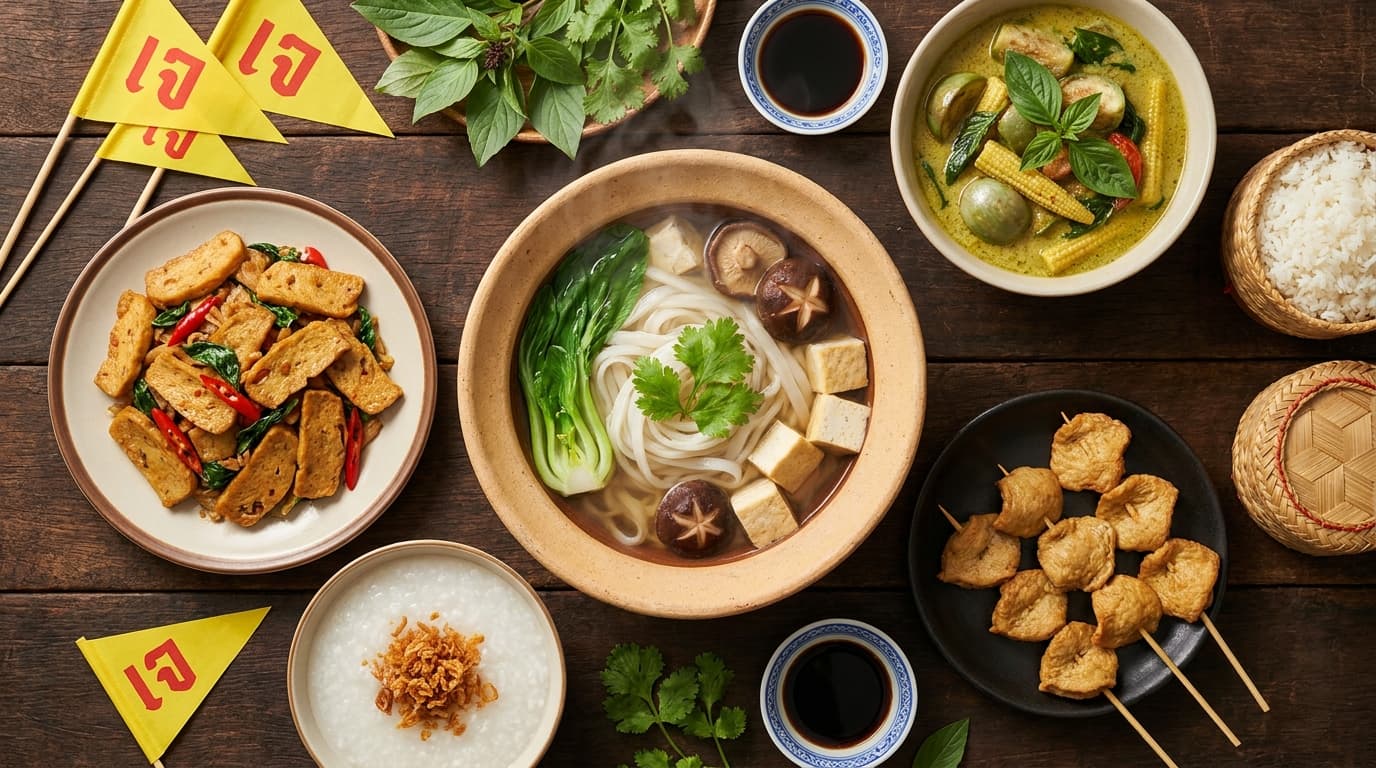
Thai Vegetarian Festival (เทศกาลกินเจ / Gin Jay) is a nine-day Thai-Chinese observance held in the ninth lunar month, most famous in Phuket where Hokkien-descended communities marked the festival from the 19th century. Participants follow strict jay (เจ) cuisine — no meat, eggs, dairy, alcohol, or the five pungent vegetables (garlic, onion, chives, leek, shallot) — believed to purify body and spirit while honoring the Nine Emperor Gods. The food framework is the festival: yellow-flagged jay stalls fill streets, mock-meat preparations from gluten and soy reach high craft, and dishes like jay noodle soup, mock-pork stir-fry, vegetarian curries with coconut milk, and rice congee anchor daily eating. Phuket's processions add dramatic body-piercing rituals, but for most Thai-Chinese households the practice is dietary — a sustained nine-day vegan discipline expressed through familiar Thai-Chinese-fusion cooking adapted to jay restrictions.
Signature Dishes
Jay noodles
Tofu and mushroom stir-fries
Vegetarian curries
Mock meats
plant-based
Chinese-style vegetarian soups
Regional Variations
Phuket (canonical center)
Hokkien-descended Thai-Chinese community, full street procession with body-piercing rituals, nine yellow-flag temples, nine-day strict communal jay observance with shared temple meals.
Bangkok urban Thai-Chinese
Yaowarat Chinatown jay stalls, family-scale household observance, mock-meat shop culture especially around Wat Mangkon Kamalawat.
Trang and Krabi (southern Thailand)
Smaller-scale temple processions, jay seafood-mimic specialties, Hokkien-temple network parallel to Phuket.
Hat Yai (Thai-Malaysian border)
Syncretic Hokkien-Teochew variants, Singapore-influenced jay imports, Malaysian Chinese diaspora cross-pollination.
Diaspora Thai-Chinese in Malaysia/Singapore
Penang and Singapore Nine Emperor Gods Festival, parallel jay observance, shared Hokkien-temple lineage.
Observance Practices
Strict jay diet for nine days: no meat, eggs, dairy, alcohol, or five pungent vegetables (garlic, onion, chives, leek, shallot); yellow-flag (ธงเหลือง) certification at jay-compliant stalls and restaurants.
Mock-meat craft cuisine: gluten "duck", soy "pork", mushroom-stem "shellfish", coconut-milk curries adapted to jay rules — a substantive Thai-Chinese culinary tradition independent of generic veganism.
Daily temple offerings of jay food at the Nine Emperor Gods altars; family altars receive smaller portions; communal temple meals open to participants.
White-clothing convention during festival days, especially for active participants and temple volunteers.
Body purification rituals (Phuket-specific): processions with mediums believed to channel the Nine Emperor Gods; non-Phuket communities observe in dietary form only, NOT a universal Thai-Chinese practice.
Phuket (canonical center)