Nepali Dashain
दशैं
About Nepali Dashain
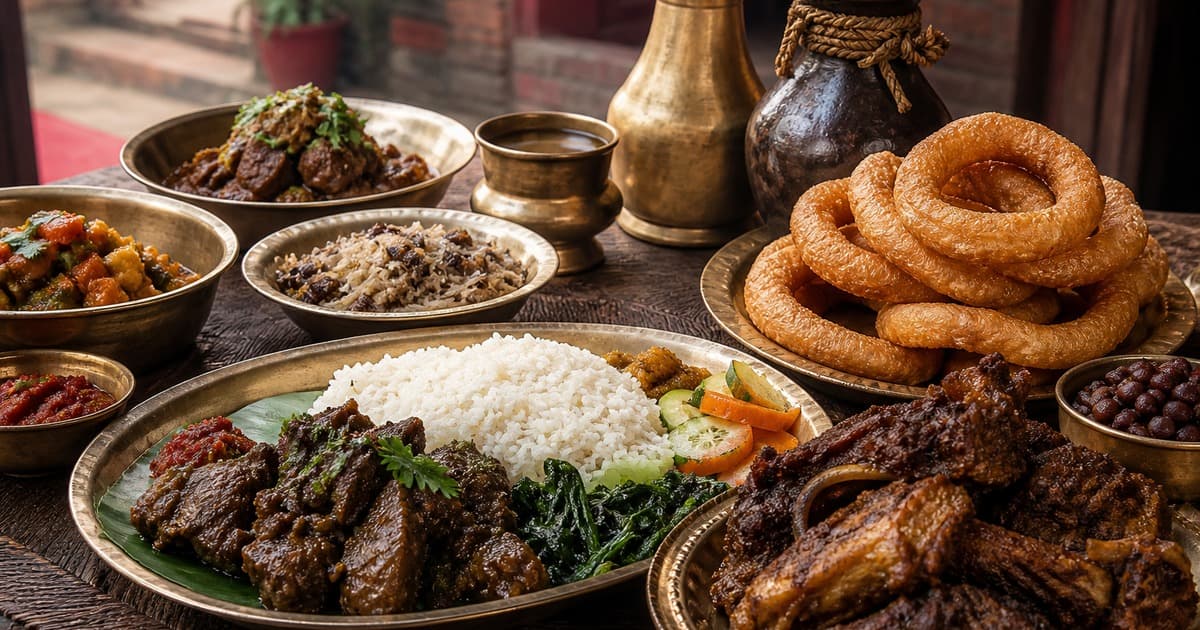
Nepali Dashain is a 15-day autumn homecoming season centered on Durga worship, elders’ tika-jamara blessings, and generous family tables. Around Maha Ashtami and Vijaya Dashami, Goat meat—often prepared as khasi ko Masu curry—is traditionally associated with offerings and shared as rich, spiced festival food. Sel roti brings a sweet, crisp-edged rice-flour fragrance to visits, commonly served with chiura, achaar, or tea; some households also pour Raksi. Newari Mohani celebrations in the Kathmandu Valley may feature bara/wo, chatamari, or yomari, while diaspora gatherings often recreate the tika table with sel roti and goat curry.
Signature Dishes
Goat meat
khasi
Sel roti
Masu
मासु
Bhatmas
भटमास
Raksi
Regional Variations
Kathmandu Valley (Newar community)
Celebrated as Mohani with distinct Newari rituals and signature dishes — Yomari, Bara/Wo, Chatamari — alongside mainstream Dashain observances.
Eastern Nepal (Limbu/Rai/Kirat communities)
Tika-Jamara timing and ritual emphasis varies per indigenous Kirat customs; some communities observe more lightly, prioritizing own ancestral festivals.
Terai (Madhesi community)
Dashain often observed with Hindi/North-Indian-adjacent customs, blending Madhesi cultural elements with mainstream Nepali Tika-Jamara.
Highland Nepal (Sherpa/Tibetan-Buddhist communities)
Dashain less centrally observed; these communities typically prioritize Lhosar as their primary festival.
Hill Nepal (Bahun-Chhetri / Pahadi Hindu mainstream)
Full 15-day Dashain arc with Ghatasthapana, Phulpati, Ashtami sacrifices, and Vijaya Dashami Tika-Jamara as the central family ritual.
Gorkha district
Historical ancestral seat of the Phulpati procession on Day 7; sacred plants traditionally carried from Gorkha to Kathmandu Hanuman Dhoka palace.
Nepali diaspora (US, UK, Australia, Gulf, Hong Kong, Japan, South Korea)
Community Tika-Jamara gatherings organized at Nepali cultural centers; Sel roti and Khasi curry served at communal meals, adapted to local meat-sourcing constraints.
Observance Practices
Ghatasthapana — establishing sacred jar and planting Jamara (yellow barley grass) on Day 1
Navaratri — daily worship of nine forms of Durga across Days 1-9
Phulpati procession — sacred plants carried from Gorkha to Kathmandu on Day 7
Nepal (national, originating Gorkha-Kathmandu axis)
Maha Ashtami — Kalratri Puja with animal sacrifices at Kalika temples and military regimental rituals at army camps on Day 8
Nepal
Maha Navami — Astra Puja and Vehicle Puja (blessing weapons, tools, cars, motorcycles) on Day 9
Vijaya Dashami Tika-Jamara ceremony — elders apply rice-yogurt-vermillion Tika and Jamara to younger relatives, giving Dakshina and blessings (central social ritual of the year)
Family visits in order of seniority across Days 10-15, receiving Tika from elder relatives
Festival meal of Khasi ko Masu (goat curry), Sel Roti, Chiura, and pickles
Kite-flying and erecting Linge Ping (bamboo swings) in villages
Nepal (rural and hill areas)
Mohani observance with Newari dishes (Yomari, Bara, Chatamari) and Newar-specific ritual cycle
Kathmandu Valley (Newar community)
Kojagrat Purnima — full-moon closing observance on Day 15
Community Tika-Jamara gatherings at Nepali cultural centers
Nepali diaspora globally
Regions
Cuisines
Related Recipes
Dal Tadka (दाल तड़का) — Indian Tempered Yellow Lentils with Ghee and Spices
commonly served·Nepali Daal-Bhaat base extension
Aloo Gobi (आलू गोभी) — Indian Potato and Cauliflower Dry Curry with Turmeric
commonly served·Nepali Tarkari adjacent
Authentic Kashmiri Lamb Rogan Josh (روغن جوش) — Wazwan-style red lamb curry
regional variant·Nepali Dashain lamb proxy (Khasi-mutton equivalent)
Afghan Lamb Do Pyaza (دو پیازه) — Lamb and Onion Stew with Double Onions
regional variant·Nepali Dashain lamb proxy (Himalayan adjacency)