Hogmanay
Scottish New Year
About Hogmanay
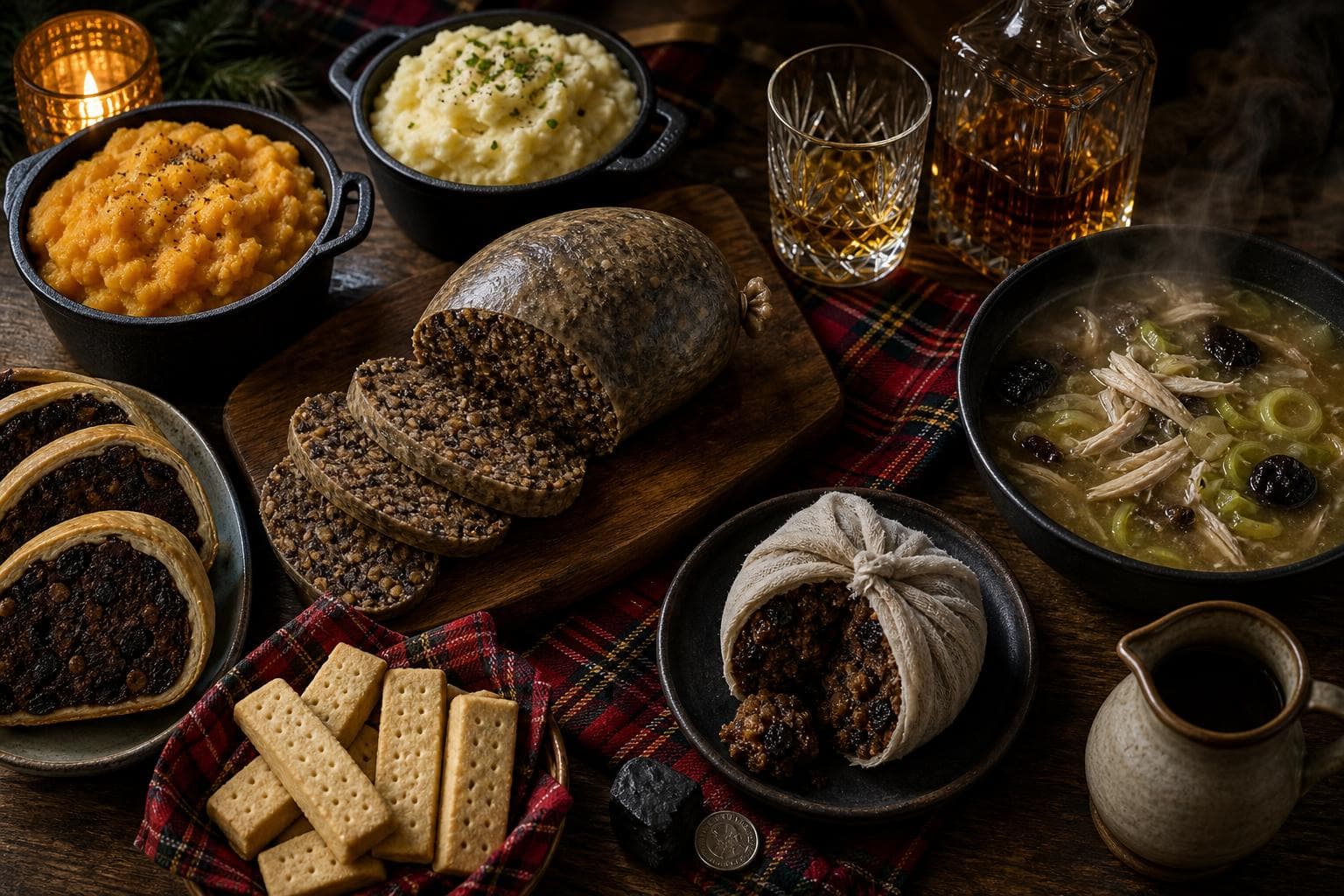
Hogmanay is the Scottish New Year's Eve celebration (December 31, Gregorian fixed) — historically more culturally central in Scotland than Christmas (minimally celebrated in Presbyterian Scotland through the 1950s). Hogmanay anchors a distinct **Scottish food canon**: **haggis** (sheep offal + oats + spices in stomach lining; Robert Burns's "Address to a Haggis" national-poem), **neeps and tatties** (mashed turnip + potatoes), **cock-a-leekie soup** (chicken + leek + prunes), **clootie dumpling** (steamed fruit-pudding in a cloth), **black bun** (fruit-cake encased in pastry, eaten at midnight), **shortbread**, and **Atholl brose** (whisky + oats + honey + cream). The festival features the iconic **first-footing tradition** (first visitor after midnight should be a tall dark-haired man bringing whisky + coal + shortbread + bun + salt) and **Auld Lang Syne**, Robert Burns's 1788 poem-song sung at midnight. **Distinct from St-Patrick's Day** — Hogmanay is Scottish-NY-cultural-distinct.
Signature Dishes
Haggis, neeps and tatties
Shortbread
Black bun
Scotch whisky
Steak pie
New Year’s Day tradition
Regional Variations
Scottish mainland (Edinburgh + Glasgow + Aberdeen)
Edinburgh's Hogmanay street party canonical (since 1993; 80,000+ attendees) + Glasgow's George Square gathering; haggis + neeps + tatties + clootie dumpling + cock-a-leekie soup + black bun midnight tradition; first-foot tradition central; Princes Street fireworks Edinburgh-canonical.
Scottish Highlands + Islands (Inverness + Orkney + Shetland)
Stronger Norse influence + Up Helly Aa fire festival adjacent (January but related); whisky-distillery focus (Highland + Speyside + Islay); Orkney/Shetland-specific bere-bannock bread + plum-duff pudding + traditional Norse-influence rituals.
Scottish Lowlands + Borders (Selkirk + Galloway)
Hogmanay singing-tradition + Galloway-cattle-show + border-ballad tradition; black bun + shortbread + cock-a-leekie soup + steak pie (New Year's Day tradition); border-Scottish-distinct from Highland traditions.
Scottish diaspora (Canada Nova Scotia + Australia + New Zealand)
Hogmanay preservation in Cape Breton (Gaelic-speaking community Scottish-Canadian-canonical) + Australia-Scottish-club Hogmanay celebrations + New Zealand-Otago-Scottish heritage observance; haggis-by-mail global market via Scottish butchers; whisky-tasting diaspora tradition.
Modern Edinburgh festival
Torchlight procession (200,000+ participants) Dec 30 + concert + Princes Street fireworks Dec 31 + Loony Dook polar plunge Jan 1; gourmet-Hogmanay food-festival expansion (Scottish chefs reinterpreting classics including vegetarian haggis variants); haggis-vegetarian modern adaptations.
Observance Practices
**First-footing tradition** — first visitor after midnight should be tall dark-haired man bringing whisky + coal + shortbread + black bun + salt (Norse-influence superstition for prosperity in new year); fair-haired or female first-foot considered unlucky in traditional belief; Norse-influence historical roots.
**Auld Lang Syne** — Robert Burns 1788 poem-song sung at midnight nationally + globally adopted (English-language New-Year-canonical); "should auld acquaintance be forgot..." verse-tradition; communal-singing across English-speaking world derived from Scottish Hogmanay tradition.
Haggis + neeps + tatties — Scottish national dish (Burns-Night-canonical Jan 25, but Hogmanay-served also); served with whisky-sauce; **NOT confused with English/British-generic-cuisine** — Scottish-distinct identity; Robert Burns's "Address to a Haggis" recited tradition.
Whisky tradition — Scotch whisky national drink; toasting + sharing tradition; "Slàinte Mhath" (Gaelic toast meaning good health); whisky-distillery tradition Highland / Speyside / Islay regional variants; New Year drams shared with first-foot visitors.
**Distinct from St-Patrick's Day** — Hogmanay is Scottish-NY-cultural framework (Dec 31, Presbyterian + Norse heritage); St-Patrick's is Irish-Catholic-saint-feast (Mar 17, Catholic + Celtic heritage); both Celtic-Brittonic origins but **distinct national identities**; Scottish-diaspora tradition preserved separately from Irish-diaspora tradition.