Mehregan
مهرگان
About Mehregan
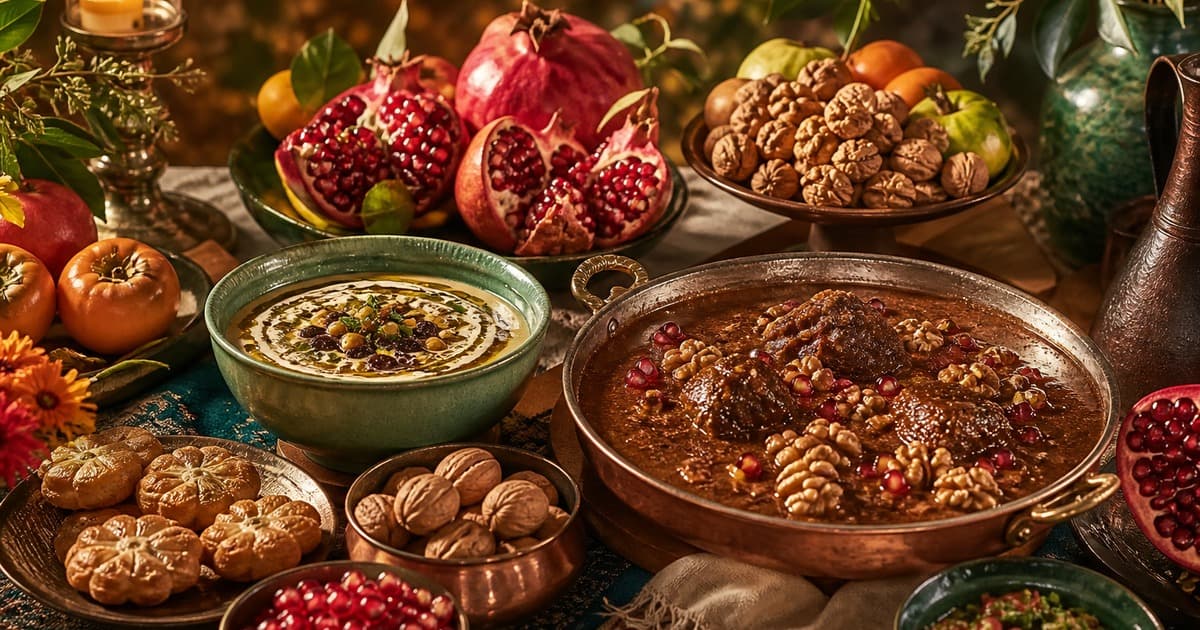
Mehregan, the ancient Persian autumn festival honoring Mithra — yazata of covenant, light, and friendship — gathers families around a sofreh-e mehr spread of pomegranates, persimmons, apples, and autumn nuts as the harvest light begins to wane. In Iran, Fesenjan, the iconic slow-simmered chicken or duck stew in pomegranate molasses and ground walnuts, anchors the table, often alongside Ash-e Mehregan, a hearty pomegranate-walnut soup, and saffron-scented rice studded with pistachios. Walnut pastries and pomegranate dishes — lavashak fruit leathers, ajeel mixed nuts, baghlava — carry the Mithraic sweetness of covenant renewal. Iranian Zoroastrian communities in Yazd and Kerman maintain the most traditional observance with Avestan recitations from the Mehr Yasht, while Parsi Zoroastrians in Mumbai, Surat, and Navsari extend the tradition through dhansak, malido, and ravo, weaving Gujarati substrate into Mithraic heritage. Afghan, Kurdish, Tajik, and Iranian diaspora communities each bring their own autumn-harvest textures — qabili pulao, Kurdish dolma, Tajik osh — to a festival that remains, at its heart, Persian-rooted and Zoroastrian-grounded.
Signature Dishes
Ash-e Mehregan
آش مهرگان
Fesenjan
فسنجان
Pomegranate dishes
غذاهای اناری
Walnut pastries
شیرینی گردویی
Regional Variations
Iran (modern Persian)
Sofreh-e mehr with pomegranates, apples, persimmons, ajeel, samanu; mirror, censer with frankincense and senjed, candle. Ash-e anar and fesenjan commonly served.
Iranian Zoroastrian (Yazd, Kerman)
Traditional observance at Atashkadeh with Avestan Mehr Yasht recitations, fire ceremonies, and offerings of fruits and grains; most liturgically intact form.
Parsi Zoroastrian (India: Mumbai, Gujarat, Surat, Navsari)
Mithra-Roj observance blending Zoroastrian heritage with Gujarati substrate; dhansak, patra ni machhi, saas ni machhi, salli boti, malido, ravo, lagan nu custard.
Afghan Persian-speaking communities (Tajik, Hazara)
Autumn harvest observance with qabili pulao (raisins, carrots), mantu, sabzi-chalow, halwa-e-aurd-sujee, and seasonal pomegranates and walnuts.
Kurdish (Iranian and Iraqi Kurdistan)
Mihregan / Mehragan-e Kurdī autumn harvest traditions; Kurdish kuku (herb omelet), dolma with grape leaves and autumn vegetables, kebab.
Tajik / Uzbek Central Asian Persianate
Tajik Mehrgōn autumnal harvest gathering with osh / palov, autumn-grain preparations, and seasonal fruits.
Iranian diaspora (US, UK, Germany, Canada, Australia)
Cultural-association gatherings often partnered with Zoroastrian centers; sofreh-e mehr, Persian classical music, ash-e anar as centerpiece.
Mazandaran / Gilan (Caspian Iran)
Rice-harvest-aligned celebration; fesenjan (chicken or duck in pomegranate-walnut sauce) particularly emblematic as a regional autumn dish.
Observance Practices
Sofreh-e Mehr ceremonial spread (haft mehr): pomegranates, apples, persimmons, autumn nuts, samanu, mirror, censer with frankincense
Recitation of the Mehr Yasht (Avestan hymn to Mithra) in prayer
Zoroastrian communities (Iranian and Parsi)
Cultural readings of Persian poetry (Hafez, Saadi, Ferdowsi) in lieu of Avestan liturgy
Secular Iranian and diaspora observance
Community gathering and feast at the Atashkadeh (fire temple)
Iranian Zoroastrian (Yazd, Kerman)
Family gatherings with extended kin and shared autumn feast
Gift exchange of autumn fruits, pomegranates, and sweets among family and friends
Renewal of social covenants, oaths, and reconciliations (Mithraic covenant-fidelity ethic)
Kindling of ceremonial fire and candles to symbolize light persisting against waning autumn sun
Private / home-based observance as cultural-heritage festival
Post-1979 Iran
Rice-harvest celebratory meals tied to local agricultural cycle
Mazandaran / Gilan
Parsi ritual preparation of malido (sweet semolina) as religiously significant offering
Parsi Zoroastrian (India)
Serving ash-e anar (pomegranate-walnut soup) as the centerpiece dish of the gathering
Iranian and Iranian diaspora
Regions
Cuisines
Related Recipes
Pomegranate Herb Soup (آش انار)
signature·Iran; Persian diaspora
Ash Reshteh (آش رشته) — Persian Herb, Bean, and Noodle Soup
commonly served·Iran; Persian diaspora
Albaloo Tahchin (ته چین آلبالو) — Persian Sour Cherry Saffron Rice Cake
commonly served·Iran
Beranj-e Shirazi (برنج شیرازی) — Shiraz-Style Jeweled Rice
commonly served·Iran; Persian diaspora
Adas Polo (عدس پلو) — Persian Lentil and Raisin Rice with Saffron
commonly served·Iran
Haft Mewa (هفت میوه) — Afghan Seven-Fruit Nowruz Compote
regional variant·Afghanistan; Persian-speaking diaspora; Parsi Zoroastrian extension