Orthodox Christmas
Рождество Христово / Рождество
About Orthodox Christmas
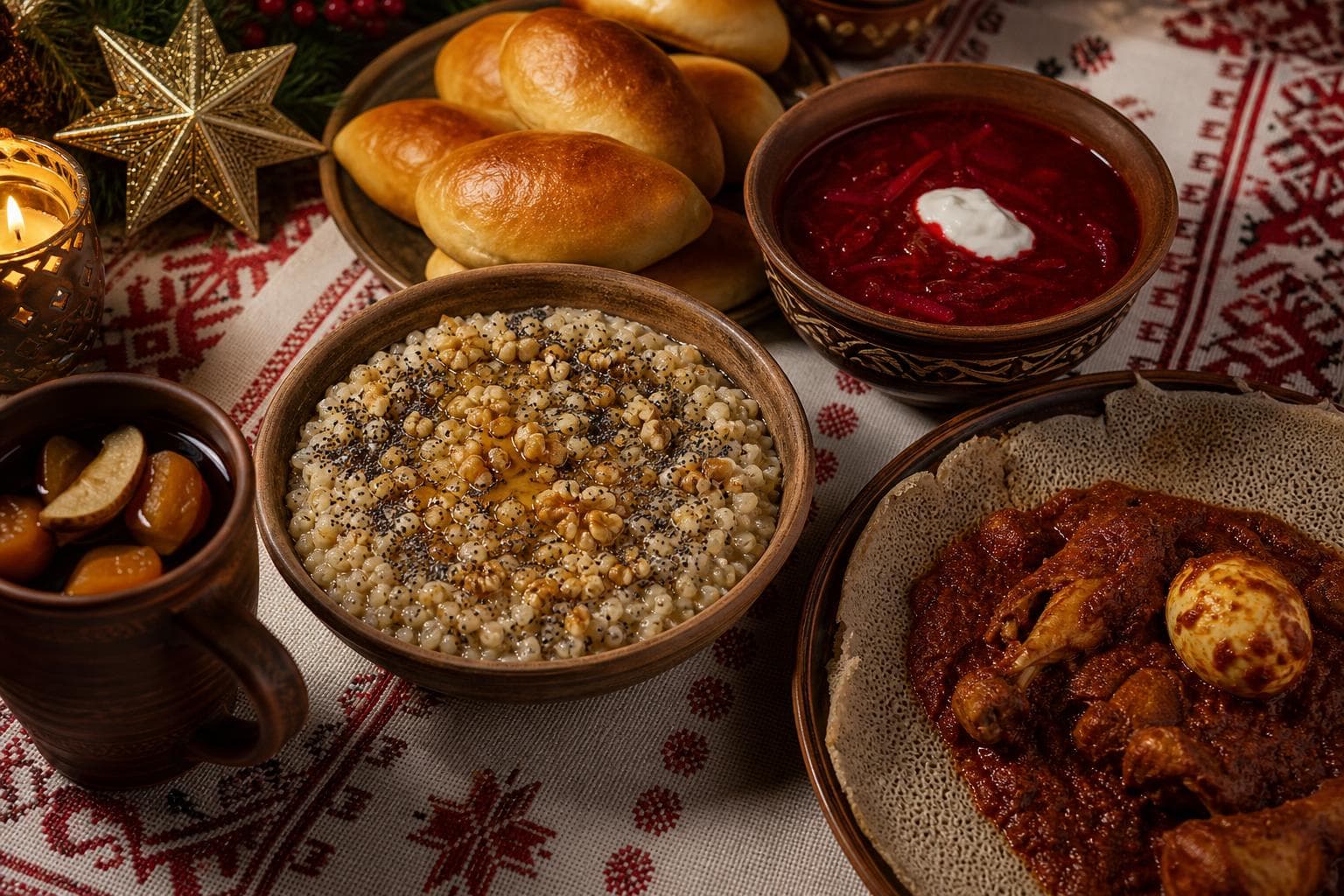
Orthodox Christmas observes the **Nativity of Christ on January 7** in churches following the **Julian calendar** — a **13-day differential** from Western Gregorian December 25. The observance spans **multiple distinct Eastern Christian traditions**: **Russian, Ukrainian, Serbian, Belarusian, and Bulgarian Eastern Orthodox** (Slavic Orthodox tradition); **Coptic Egyptian Orthodox** (observing Christmas as **Kiahk 29** in the Coptic calendar, also January 7); **Ethiopian Tewahedo Orthodox** (observing **Genna** on Tahsas 29 Ethiopian calendar, also January 7); and **Armenian Apostolic** (observing Theophany-and-Nativity-combined traditionally on January 6, Jerusalem Armenian Patriarchate retaining original Eastern computus). Most Orthodox traditions observe a **40-day Nativity Fast** beforehand (Advent of Eastern Orthodox tradition), shaping the Christmas Eve table toward meatless dishes. Food anchors are deeply symbolic: **Kutia** (Slavic wheat berries + honey + poppy seed + nuts, the central ritual dish), **Borscht** (beet soup, Christmas Eve variant fasting-meatless), **Pirozhki** (filled buns), **Uzvar** (dried fruit compote), and Ethiopian **Doro Wat** + Coptic **Foul medames** + Armenian **Khash** for non-Slavic Eastern traditions.
Signature Dishes
Kutia / кутя
Borscht
Pirozhki / пирожки
Fish and mushroom dishes
Compote
uzvar
Regional Variations
Russian Orthodox (largest Slavic Orthodox tradition)
Russian Orthodox Christmas centers on Christmas Eve (Сочельник, Sochelnik) 12-dish meatless dinner ending the 40-day Nativity Fast; Kutia central ritual dish with wheat berries + honey + poppy seed + nuts symbolizing ancestral blessing; Vzvar (dried fruit compote) toast; first star sighting signals meal beginning; Christmas Day Jan 7 with goose or roast meat breaking fast.
Ukrainian Orthodox + Ukrainian Greek Catholic (Uniate)
Ukrainian Sviata Vechera (Holy Supper) Christmas Eve features 12 meatless dishes representing 12 apostles: Kutia + Borscht + Varenyky (pierogi) + Holubtsi (cabbage rolls) + Uzvar dried-fruit compote + Pampushky (garlic buns) + Roasted fish; carolers (kolyadnyky) visit homes; didukh (sheaf of wheat) ceremonial display.
Serbian + Bulgarian + Macedonian Orthodox
Serbian Badnji Dan (Christmas Eve) features Badnjak oak-log burning ceremony + Česnica wheat-bread with hidden coin (finder receives year of blessing); Serbian Orthodox 12-dish meatless table; Bulgarian Бъдни вечер (Budni vecher) similar 7+ meatless dishes (banitsa, tikvenik, sarmi); Macedonian Pita Christmas Eve traditions.
Coptic Egyptian Orthodox (Kiahk 29 = January 7 Gregorian)
Coptic Orthodox Christmas in Kiahk month, observed January 7 Gregorian; Coptic Christmas Eve meatless dinner ending 43-day Coptic Nativity Fast (longest fast in Christianity); Foul medames + Koshari + Molokhia + lentils + tahini; Christmas Day fattah (rice + bread + meat-broth + lamb breaking fast); Coptic Christmas Cake (Bouhrkhar) sweet bread.
Ethiopian Tewahedo Orthodox (Tahsas 29 = January 7 Gregorian) — Genna
Ethiopian Christmas (Genna / Ledet) celebrated January 7 ending 43-day Nativity Fast (Tsome Nebiyat); Doro Wat (spiced chicken stew with berbere + niter kibbeh + hard-boiled egg, signature feast dish) + Injera + Tibs (sautéed meat) + Atakilt Wat (cabbage); coffee ceremony with three rounds (abol/tona/baraka); Ethiopian Orthodox 56-million faithful largest non-Slavic Eastern Orthodox church.
Armenian Apostolic (January 6 Theophany-Nativity combined — original Eastern computus)
Armenian Apostolic Church retains original Eastern computus combining Nativity + Theophany on January 6 (Jerusalem Patriarchate alone preserves original date) — distinct from January 7 Slavic Orthodox; Armenian Christmas Eve Khettum supper with rice pilaf + fish + Anush abur (sweet wheat-berry pudding similar to Kutia) + Gata sweet bread; abstinence from meat day-of; Armenian diaspora retains tradition.
Antiochian + Greek Orthodox (December 25 modern shift) + global Orthodox diaspora
Note: Greek Orthodox Church transitioned to Revised Julian calendar 1924 (now observes Dec 25 alongside Western Christmas); Antiochian + most Middle Eastern Orthodox + Russian/Ukrainian/Serbian/Bulgarian retain Old Julian Jan 7. Diaspora communities preserve traditional dates with cultural-Orthodox sub-community adaptations (Brooklyn Russian/Ukrainian + Sydney Coptic + DC Ethiopian + Glendale Armenian).
Observance Practices
Julian calendar Jan 7 Nativity observance — 13-day differential from Western Gregorian Dec 25; preserved by Russian/Ukrainian/Serbian/Bulgarian/Coptic/Ethiopian Orthodox; Greek Orthodox shifted to Revised Julian 1924 (now Dec 25)
Eastern Orthodox + Oriental Orthodox
40-day Nativity Fast (Eastern Orthodox Advent) preceding Christmas, ending with Christmas Eve meatless 12-dish supper (Slavic tradition representing 12 apostles); Coptic + Ethiopian observe 43-day Nativity Fast (longest in Christianity)
Slavic Christmas Eve 12-dish meatless table centered on Kutia (wheat berries + honey + poppy seed + nuts, ancestral blessing symbolism), accompanied by Borscht, Varenyky/Pierogi, Holubtsi cabbage rolls, Uzvar dried-fruit compote, Pampushky garlic buns, and roasted fish; first star sighting signals meal begin
Slavic Orthodox
Coptic Egyptian + Ethiopian Tewahedo distinct food traditions: Coptic break-fast Foul medames + Fattah + Bouhrkhar sweet bread; Ethiopian Genna feast Doro Wat + Injera + Tibs + coffee ceremony with three traditional rounds (abol + tona + baraka) — these are NOT subsets of Russian Orthodox but distinct Oriental Orthodox traditions
Coptic + Ethiopian
Armenian Apostolic combined Nativity-and-Theophany on January 6 (original Eastern computus preserved by Jerusalem Patriarchate alone); Anush abur sweet wheat-berry pudding (Armenian cognate of Slavic Kutia) + Khettum supper rice pilaf + Gata sweet bread
Armenian Apostolic