Tu BiShvat / New Year for Trees
ט״ו בשבט
About Tu BiShvat / New Year for Trees
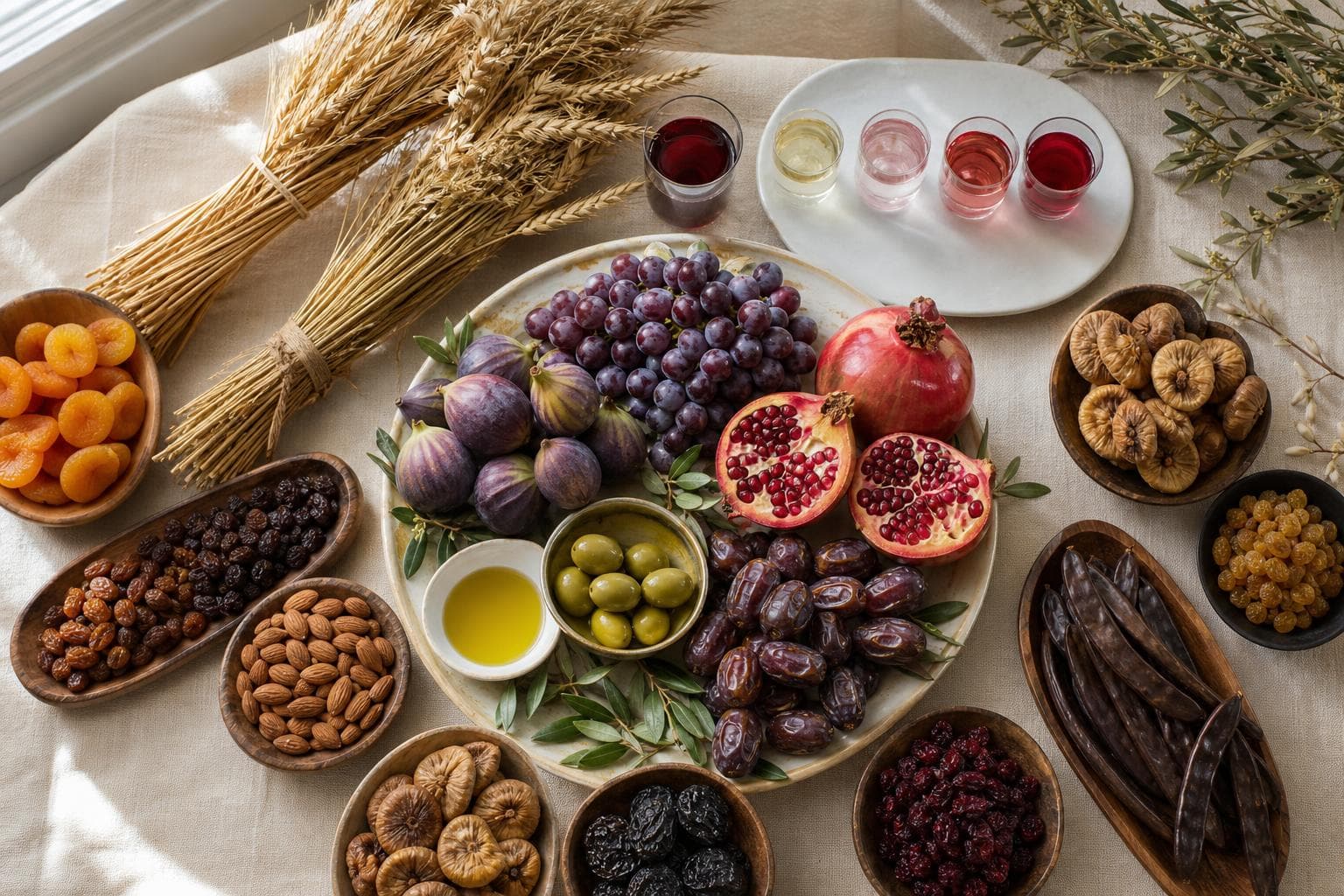
Tu BiShvat (Hebrew "the 15th of Shevat", ט״ו בִּשְׁבָט) is the Jewish New Year for Trees, originally a halachic tithing-cutoff date for tree fruit in the Land of Israel that evolved through the 16th-century Lurianic Kabbalists of Safed into a mystical food-seder and into the modern era as both an Israeli ecological-Zionist tree-planting day (championed by **JNF / Keren Kayemet LeIsrael**) and a diaspora Jewish food-festival anchored in the **Seven Species (Shiv'at HaMinim)** of Deuteronomy 8:8 — **wheat, barley, grapes, figs, pomegranates, olives, dates**. The **Tu BiShvat seder** (4 cups of wine white→pink→rosé→red corresponding to 4 mystical worlds Asiyah, Yetzirah, Beriah, Atzilut; fruit categories matching each world) anchors the seder tradition Sephardic-Levantine in origin, later adopted by Ashkenazi diaspora. **Carob (bokser / חרוב)** — the iconic "hardiness" fruit that survives long sea journeys — anchors the Persian-Jewish + Sephardic diaspora memory of "what we ate in winter when no fresh fruit was available."
Signature Dishes
Dried fruits and nuts
Carob
חרוב
Pomegranates
Olives and olive oil tastings
Seven Species foods
Regional Variations
Ashkenazi (Eastern European + Russian)
Dried fruit kompot (apricots + prunes + raisins simmered with cinnamon); bokser (long brown carob pods) as the iconic 'desert food' of Ashkenazi children's Tu BiShvat memory; etrog jam preserved from Sukkot use; honey-drizzled apples + figs + dates in family seders; almond cake / lekach variants with Seven Species nuts.
Sephardic (Iberian-Mediterranean diaspora)
Origin tradition of the Tu BiShvat seder (Lurianic-Kabbalistic 16th-century Safed); meyvalı Turkish-Jewish dried fruit assortment platters; date-charoset Levantine variant (distinct from Ashkenazi apple-walnut Passover charoset — pure dates + walnuts + wine, year-round Tu BiShvat suitable); pomegranate-molasses-glazed nuts; bourekas with dried-fruit filling.
Mizrahi (Middle Eastern Jewish — distinct from Persian cuisine; multi-substrand: Iraqi, Yemenite, Syrian, Bukharan, Persian-Jewish, Egyptian)
Iraqi-Jewish: Baghdadi date charoset + dried-fruit composts simmered with cardamom + dates stuffed with walnuts (Tu BiShvat staple) + Baghdadi halek (date syrup) drizzled on Seven Species. Yemenite: tamarind paste (homar) + dates with samneh (clarified butter) + jachnun baked overnight for the seder breakfast. Syrian (Aleppo/Damascus): kishka (kosher Tu BiShvat variant) + date-filled ma'amoul (Aleppo-canonical) + grape-leaf-wrapped dried-fruit packages. Bukharan (Central Asian): dried-fruit majun combining 7+ dried fruits + nokol sugared almonds + plov garnished with raisins + dried apricots + barberries adapted for Tu BiShvat. Persian-Jewish sub-strand (one substrand of Mizrahi — NOT generic Persian cuisine): haft mewa (haft=7, mewa=fruits — Persian-Jewish Tu BiShvat seven-dried-fruits parallel; Persian-Jewish-distinct, NOT Persian national-default) + sangak bread with Seven Species toppings. Egyptian-Jewish: mish-mishia apricot paste sheets + dried-fruit compote with rose water + basboussa with dates.
Israeli (modern post-1948)
Tree-planting ceremonies (JNF / Keren Kayemet LeIsrael) — children's planting days at JNF forests + youth movement institutional Tu BiShvat seders distributed nationwide; emphasis on Israeli-grown fruits beyond the canonical seven (etrog, persimmon, sabra cactus fruit, almond blossoms); restaurant-led Tu BiShvat tasting menus in major Israeli cities; ecological-sustainability framing modern.
Diaspora Contemporary Fusion (NYC + LA + London + Paris)
Contemporary Tu BiShvat seders mixing all 5 above traditions in single multi-night programs; restaurant-led Tu BiShvat tasting menus in major Jewish-American cities; ecological + climate-justice framing in progressive synagogues; community-supported-agriculture Tu BiShvat fruit boxes; expanded Seven Species + local-and-Israeli fresh produce.
Observance Practices
Seven Species tasting — wheat (in matzah-like breads or whole grain), barley, grapes (or wine), figs, pomegranates, olives or olive oil, dates — sequentially or as a composed platter; the Seven Species are the canonical foods of the Land of Israel from Deuteronomy 8:8; bracha (blessing) recited before each species.
Tu BiShvat seder — Lurianic-Kabbalistic 16th-century Safed origin; 4 cups of wine progressing white → pink → rosé → red corresponding to 4 mystical worlds (Asiyah, Yetzirah, Beriah, Atzilut); fruit categories matching each world (encased shells / encased pits / fully edible) — Sephardic-Levantine in origin, later adopted by Ashkenazi diaspora.
Tree-planting (Israeli modern) — JNF / Keren Kayemet LeIsrael annual planting drive; children plant saplings at JNF forests; community-supported-agriculture Tu BiShvat fruit boxes in diaspora; ecological + climate-justice framing in progressive communities.
Carob (bokser / חרוב) symbolism — the iconic 'hardiness' food that survives long sea journeys; carob pods anchor the Persian-Jewish + Sephardic diaspora memory of 'what we ate in winter when no fresh fruit was available'; eaten dried as Tu BiShvat reminder of resilience.
NOT a major fast-day OR observance — Tu BiShvat is a minor Jewish festival (work permitted; no liturgical reading); historically a halachic tithing-cutoff date for tree fruit in ancient Israel; elevated culturally through Lurianic Kabbalist seder + modern Zionist tree-planting movement.