Halim Bademjan (حلیم بادمجان) — Persian Eggplant and Wheat Porridge
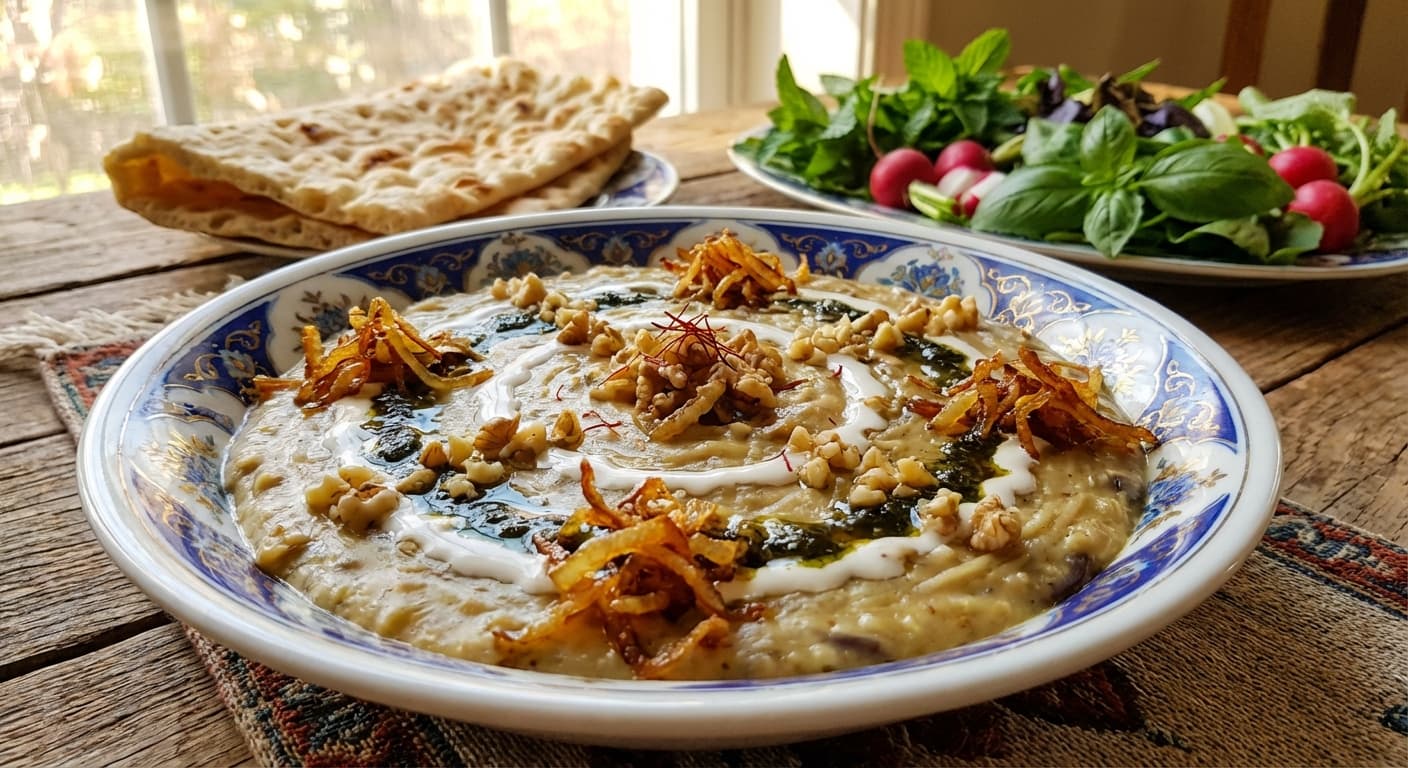
Halim Bademjan is a classic Persian comfort dish made by slowly cooking wheat and tender eggplant into a silky, spoonable porridge, then finishing it with fragrant mint oil and saffron. Often served as a hearty appetizer or light main, it showcases the Persian love of slow-cooked textures and aromatic toppings like fried onions and kashk.
Printable Recipe Card
Servings: 6 · Total: 145 min · Difficulty: medium
Ingredients (quick list)
- 220 g Pearled wheat (rinsed well)
- 1500 ml Water (plus more as needed)
- 900 g Eggplant (about 3 medium; peeled and cut into 3 cm pieces)
- 10 g Salt (for salting eggplant to reduce bitterness)
- 75 ml Neutral oil (for frying eggplant)
- 300 g Yellow onions (thinly sliced)
- 18 g Garlic cloves (about 6 cloves; finely grated or minced)
- 2 tsp Ground turmeric
- 1 tsp Ground black pepper
- 2 tbsp Dried mint
- 0.25 tsp Saffron threads (finely crushed)
- 60 ml Hot water (for blooming saffron)
+ 2 more in the full ingredients section below.
Steps (summary)
- Rinse the pearled wheat under cold water until the water runs mostly clear. Add it to a pot with 1500 ml water and bring to a b…
- While the wheat cooks, salt the eggplant: toss the eggplant pieces with 10 g salt and let them sit in a colander for 20 minutes…
- Heat 75 ml neutral oil in a wide skillet over medium-high heat. Fry the eggplant in batches until deeply golden and very soft,…
- In the same skillet, add 30 ml neutral oil and the sliced onions. Cook over medium heat for 12–15 minutes, stirring often, unti…
- Add the minced garlic to the skillet with the remaining onions and cook for 60 seconds until fragrant. Stir in the turmeric and…
- Scrape the eggplant-onion mixture into the pot of simmering wheat. Add 200 ml additional water if the pot looks dry; the mixtur…
+ 4 more steps in the full instructions section below.
Cultural Background
Halim Bademjan is a beloved Persian dish associated with patient, slow cooking and communal serving, often appearing on family tables and at gatherings as a warm, shareable starter. Its hallmark toppings—mint oil, fried onions, saffron, and kashk—reflect classic Iranian flavor-building techniques that balance richness with herbal aroma.
Equipment
💡 Tips
- For the most authentic texture, keep simmering and stirring after blending; the dish should become cohesive and slightly stretchy rather than soupy.
- Fry eggplant until very soft and deeply golden—under-fried eggplant will taste raw and won’t blend into a silky porridge.
- Add mint to warm (not hot) oil and remove quickly; burnt mint turns bitter in seconds.
⚠️ Common Mistakes
❌ Not stirring the wheat base often enough, causing scorching at the bottom of the pot.
✅ Fix: Use a heavy-bottom pot, keep the heat low after boiling, and stir every 5–10 minutes; add 50–100 ml water if it tightens too quickly.
❌ Burning the dried mint in hot oil, making the topping bitter.
✅ Fix: Warm the oil gently, add mint off strong heat, stir for 20–30 seconds, and remove immediately when fragrant.
❌ Adding kashk and then boiling hard, which can cause curdling and grainy texture.
✅ Fix: Lower the heat before adding kashk and keep the mixture at a gentle simmer, stirring continuously.
🧊 How to Store
Cool to room temperature within 2 hours, then refrigerate in an airtight container for up to 4 days. Reheat gently in a saucepan over low heat with 80–150 ml water, stirring often to restore the porridge texture; avoid boiling after adding kashk. Mint oil and fried-onion garnish are best made fresh, but can be stored separately refrigerated for 2 days and rewarmed briefly.
📅 Make Ahead
Cook the wheat up to 1 day ahead and refrigerate; reheat with 200 ml water before adding the fried eggplant mixture. Fried onions can be made 2 days ahead and refrigerated; re-crisp in a dry skillet for 2 minutes. Mint oil is best prepared right before serving for the freshest aroma.
🍽️ Pairs Well With
- Sangak or lavash bread
- A side of fresh herbs (mint, basil, radish) measured as 1 bunch
- Pickles (torshi) and a squeeze of fresh lemon (15 ml) if desired
Regional Variations
- Isfahan-style serving often emphasizes generous kashk and fried onion topping, sometimes with a richer, thicker consistency for scooping with bread.
- Some home cooks add 150 g cooked shredded lamb or beef for a heartier version, though the vegetarian style is also traditional and widely loved.
Ingredients
- 220 gPearled wheat (rinsed well)
- 1500 mlWater (plus more as needed)
- 900 gEggplant (about 3 medium; peeled and cut into 3 cm pieces)
- 10 gSalt (for salting eggplant to reduce bitterness)
- 75 mlNeutral oil (for frying eggplant)
- 300 gYellow onions (thinly sliced)
- 18 gGarlic cloves (about 6 cloves; finely grated or minced)
- 2 tspGround turmeric
- 1 tspGround black pepper
- 2 tbspDried mint
- 0.25 tspSaffron threads (finely crushed)
- 60 mlHot water (for blooming saffron)
- 180 gKashk (Persian whey; diluted with 60 ml water if very thick)
- 40 gWalnut halves (lightly chopped)
🔄 Substitutions
- Kashk→ Greek yogurt
- Pearled wheat→ Cracked wheat (bulgur), fine
- Walnut halves→ Slivered almonds
Instructions
- 1
Rinse the pearled wheat under cold water until the water runs mostly clear. Add it to a pot with 1500 ml water and bring to a boil, then reduce to a gentle simmer. Cook partially covered for 60 minutes, stirring every 10 minutes so the wheat does not stick and scorch.
- 2
While the wheat cooks, salt the eggplant: toss the eggplant pieces with 10 g salt and let them sit in a colander for 20 minutes. Rinse quickly under cold water, then pat very dry with paper towels to prevent oil splatter. Drying well also helps the eggplant brown instead of steaming.
- 3
Heat 75 ml neutral oil in a wide skillet over medium-high heat. Fry the eggplant in batches until deeply golden and very soft, 8–10 minutes per batch, adding a splash more oil only if the pan becomes dry. Transfer the fried eggplant to a plate lined with paper towels to drain.
- 4
In the same skillet, add 30 ml neutral oil and the sliced onions. Cook over medium heat for 12–15 minutes, stirring often, until the onions are evenly golden-brown and sweet. Remove about one-third of the onions to a small bowl for garnish, keeping the rest in the skillet.
- 5
Add the minced garlic to the skillet with the remaining onions and cook for 60 seconds until fragrant. Stir in the turmeric and black pepper and cook for 30 seconds to bloom the spices. Add the fried eggplant and stir for 1 minute to coat it with the onion-spice mixture.
- 6
Scrape the eggplant-onion mixture into the pot of simmering wheat. Add 200 ml additional water if the pot looks dry; the mixture should be loose enough to stir easily. Simmer partially covered for 35 minutes, stirring frequently, until the eggplant collapses and the wheat is very tender.
- 7
Use an immersion blender to partially blend the mixture until it becomes thick, creamy, and porridge-like, with a few small strands remaining for texture. If using a potato masher instead, mash vigorously for 3–4 minutes until the eggplant breaks down and the wheat becomes cohesive. Continue to simmer for 10 minutes, stirring constantly, to develop the signature stretchy, unified texture.
- 8
Bloom the saffron by mixing the crushed saffron threads with 60 ml hot water and letting it steep for 5 minutes. Stir the saffron water into the pot and simmer for 3 minutes so the color and aroma disperse. If the halim becomes too thick to stir, loosen it with 50–100 ml water and cook 2 minutes more.
- 9
Stir in the kashk (diluted with 60 ml water if needed) and cook for 5 minutes over low heat, stirring continuously so it does not curdle or stick. Taste and adjust salt by adding 1–2 g more if necessary, keeping in mind kashk is naturally salty. Turn off the heat and let the halim rest for 5 minutes to thicken slightly.
- 10
Make the mint oil: warm 30 ml neutral oil in a small pan over low heat for 30 seconds, then add the dried mint. Stir for 20–30 seconds just until the mint darkens slightly and becomes aromatic, then immediately remove from heat to prevent bitterness. Spoon the halim into a serving dish and top with the reserved fried onions, mint oil, and chopped walnuts before serving.
🪪 Recipe Passport
Cultural Background
Halim Bademjan is a beloved Persian dish associated with patient, slow cooking and communal serving, often appearing on family tables and at gatherings as a warm, shareable starter. Its hallmark toppings—mint oil, fried onions, saffron, and kashk—reflect classic Iranian flavor-building techniques that balance richness with herbal aroma.
Regional Variations
Researched from multiple sources and validated by the Zaffaron editorial team. Every recipe is tested for accuracy, measurements, and cultural authenticity.
Nutrition per serving
Pairs well with
If you enjoyed this recipe, here are a few related Zaffaron recipes to try next.
Does your family make this differently?
Every family has their own version. Maybe your grandmother adds a secret ingredient, or your aunt has a completely different technique. Preserve your family's version — with their name on it, forever.
You Might Also Like
Chicken Stuffed Cabbage Rolls (دلمه کلم با مرغ) — Herb-Scented Persian Dolmeh in Tomato Saffron Sauce
Persian · Main Courses · 90 min
Baghali Polo (باقالی پلو) — Persian Dill and Fava Bean Rice with Saffron
Persian · Rice Dishes · 95 min
Pasta with Walnut Sauce (پاستا با سس گردو) — Creamy Persian Walnut-Yogurt Pasta
Persian · Main Courses · 35 min

Mont Lin Ma Yar (မုန့်လင်မယား) — Burmese Husband-and-Wife Rice Cakes
Burmese · Appetizers · 65 min
Hákarl (Hákarl) — Icelandic Fermented Shark Bites
Icelandic · Appetizers · 15 min
Chicken Chygyrtma (Toyuq Çığırtması) — Azerbaijani Chicken with Eggs and Tomatoes
Azerbaijani · Main Courses · 65 min
Turkish Cağ Kebab (Cağ Kebabı) — Erzurum Slow-Roasted Charcoal Lamb Skewer
Turkish · Kebabs · 160 min
Spas (Սպաս) — Armenian Yogurt-and-Wheat Soup
Armenian · Soups · 70 min
Reviews
Cooked this recipe?
Tap the stars to rate it — that's all it takes. A few words are welcome but optional.
No ratings yet. Cooked this one? Be the first to rate it — it takes one tap.