Eid al-Adha
عيد الأضحى
About Eid al-Adha
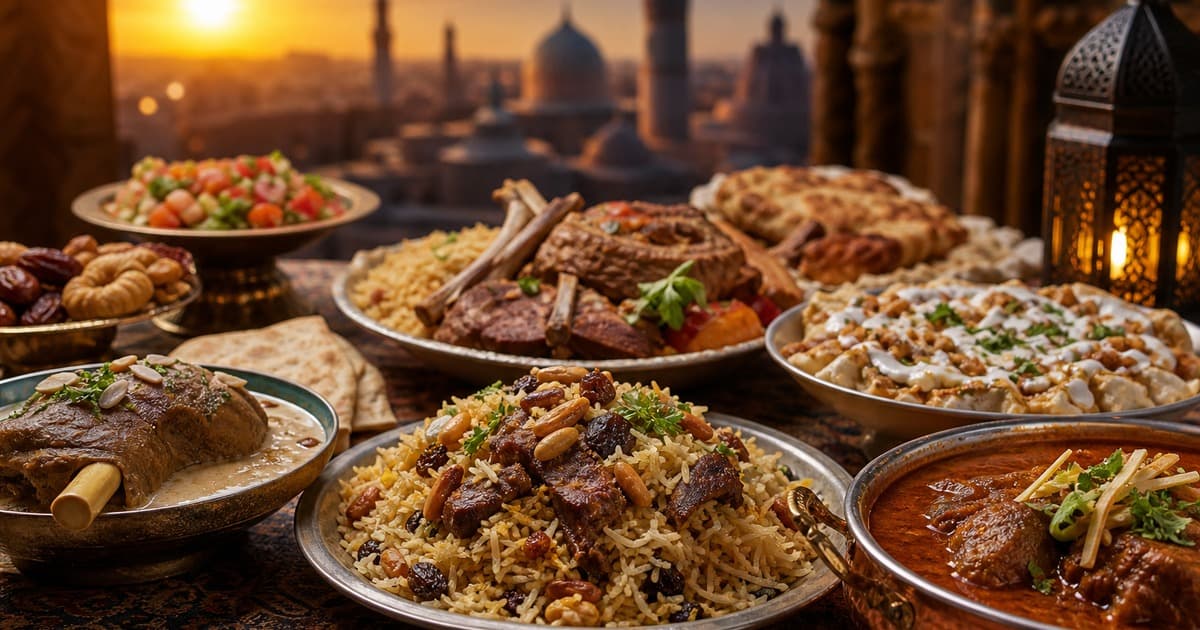
Eid al-Adha, the Feast of Sacrifice, marks the conclusion of Hajj and commemorates Prophet Ibrahim's willingness to sacrifice his son. The Qurbani sacrifice anchors the day, with meat traditionally divided in thirds among family, neighbors, and those in need — a ritual that flowers into wildly distinct regional tables. In Jordan and the Levant, communal platters of Mansaf — lamb simmered in tangy fermented jameed yogurt over rice — are eaten by hand. Gulf households often prepare Kabsa, fragrant with cardamom and dried lime, while South Asian families slow-cook Nihari overnight and lay out goat biryani, sheer-khurma, and shami kebabs for Bakra Eid. Egyptian kitchens are perfumed with Fatta, layers of rice, crisp bread, and Qurbani lamb under garlicky vinegar broth. Across Morocco, Mrouzia sweetens lamb with honey and almonds; in Indonesia, rendang slow-darkens for hours; in Senegal, Tabaski brings whole roasted lamb and mafé to the courtyard. Each table honors the same blessed meat in its own mother tongue.
Signature Dishes
Qurbani meat dishes
Mansaf
منسف
Kabsa
كبسة
Nihari
Fatta
فتة
Regional Variations
Turkish (Kurban Bayramı)
Slow-roasted lamb and mutton kebabs, kavurma (lamb sautéed in its own fat), etli pilav with chickpeas, tas kebabı stew, helva at communal gatherings.
Arab Gulf / Levantine
Mansaf (Jordanian lamb in jameed yogurt over rice), ouzi/quzi whole roasted lamb, maqluba, lahm bi ajeen, harees, maamoul, baklava, knafeh.
Maghrebi (Morocco, Tunisia, Algeria, Libya, Mauritania)
Mrouzia (lamb with honey, raisins, almonds) is the Eid al-Adha signature; tagine boulfaf offal skewers Eid morning, couscous, sellou/sfouf.
South Asian (Pakistan, India, Bangladesh)
Known as Bakra Eid; mutton/goat biryani (Hyderabadi, Lucknowi), korma, nihari, haleem, shami and boti kebabs from Qurbani meat, sheer-khurma, lachha sevaiyan.
Indonesian / Malaysian (Hari Raya Haji / Idul Adha)
Rendang (Padang slow-cooked spiced beef/buffalo), sate kambing, gulai kambing, ketupat, lemang glutinous rice in bamboo, Malaysian nasi briyani.
West African (Senegalese Tabaski; Mali, Nigeria Hausa-Fulani, Gambia)
Tabaski roasted whole lamb, mafé peanut-lamb stew, yassa with lamb, suya skewers, tuwo shinkafa with miyan kuka.
East African / Horn of Africa (Somali, Eritrean, Ethiopian Muslim, Sudanese)
Sukhaar stir-fried lamb, bariis iskukaris Eid rice, sambusa lamb pastries, Sudanese kibda lamb liver tradition, hilbeh fenugreek paste.
Persian / Iranian (Eid e-Qurban)
Twelver Shia observance with communal Qurbani charity, family lamb meals; khoresh-e gheymeh-nesar at festive tables. One regional variant among many, not a default.
Afghan (Eid e-Qurban / Loya Eid)
Kabuli pulao with lamb, mantu dumplings, bolani stuffed flatbreads, sheer-yakh for dessert.
Central Asian (Uzbek, Tajik, Kazakh, Kyrgyz Qurban Hayit)
Plov/osh/palov lamb pilaf, manti dumplings, shashlik skewers, beshbarmak communal lamb-and-noodle dish among Kazakhs and Kyrgyz.
Balkan Muslim (Bosnian, Albanian, Kosovar Kurban Bajram)
Kurban-pita meat-stuffed Bosnian pita, sogan-dolma onion dolma, ajvar accompaniments, bey halva.
South African Cape Malay (Bo-Kaap)
Boeber vermicelli-milk pudding, bobotie at communal meals, akhni rice with lamb, samoosas.
Observance Practices
Salat al-Eid: communal two-rakat Eid prayer with khutbah at mosque or open prayer ground on Eid morning, performed before any meal.
Qurbani / Udhiyya: sacrifice of a permitted animal (sheep, goat, cow, or camel) after Eid prayer; legitimate window from after Day 1 Eid prayer through sunset of 12 Dhul Hijjah.
Thirds rule for sharing Qurbani meat: roughly one-third for family, one-third for relatives and neighbors, one-third for the poor and needy.
Pooled Qurbani donations to charity organizations who slaughter on the donor's behalf, common among non-meat-eating or diaspora households.
Hajj pilgrims at Mina perform Qurbani as part of Hajj rites, followed by Tawaf al-Ifadah and remaining stoning over Days 2-3.
Hajj pilgrims at Mecca/Mina
Eid Takbir recitation (Allahu akbar) continuously from Fajr of 9 Dhul Hijjah (Day of Arafah) through Asr of 13 Dhul Hijjah (Tashreeq days).
New clothes, family visits, Eidi gift-giving to children, and charitable giving (zakat al-mal often timed to Eid).
Three to four days of celebration spanning the Tashreeq days (10-12, sometimes through 13 Dhul Hijjah).
Visiting cemeteries and graves of family members on or around Eid.
Egyptian, Turkish, South Asian traditions
Eid al-Adha morning offal meals from the freshly sacrificed lamb (e.g. tagine boulfaf, Sudanese kibda).
Maghrebi and Sudanese traditions
Date observance: Sunni majority follow Saudi Umm al-Qura or local moon-sighting authority; Twelver Shia authorities (Iran, Iraq, Lebanon) may declare ±1 day independently.
Regions
Cuisines
Related Recipes
Hyderabadi Lamb Biryani (بریانی حیدرآبادی) — Indian Layered Saffron Rice with Spiced Lamb
signature·South Asian Muslim communities (Hyderabad, Lucknow, Pakistani, Bangladeshi)
Authentic Kashmiri Lamb Rogan Josh (روغن جوش) — Wazwan-style red lamb curry
commonly served·South Asian (Kashmir, North Indian Muslim)
Adana Kebab (آدانا کباب) — Turkish Spicy Minced Lamb Skewers
commonly served·Turkish Muslim (Anatolian)
Hashweh (حشوة) — Lebanese Spiced Lamb and Rice Stuffing with Pine Nuts
commonly served·Levantine Arab (Lebanese, Jordanian, Syrian, Palestinian)
Couscous Royal (كسكسو رويال) — Moroccan Seven-Vegetable Couscous with Lamb and Merguez
regional variant·North African (Moroccan, Algerian, Tunisian)
Afghan Lamb Do Pyaza (دو پیازه) — Lamb and Onion Stew with Double Onions
regional variant·Afghan Muslim communities