Holi
होली
About Holi
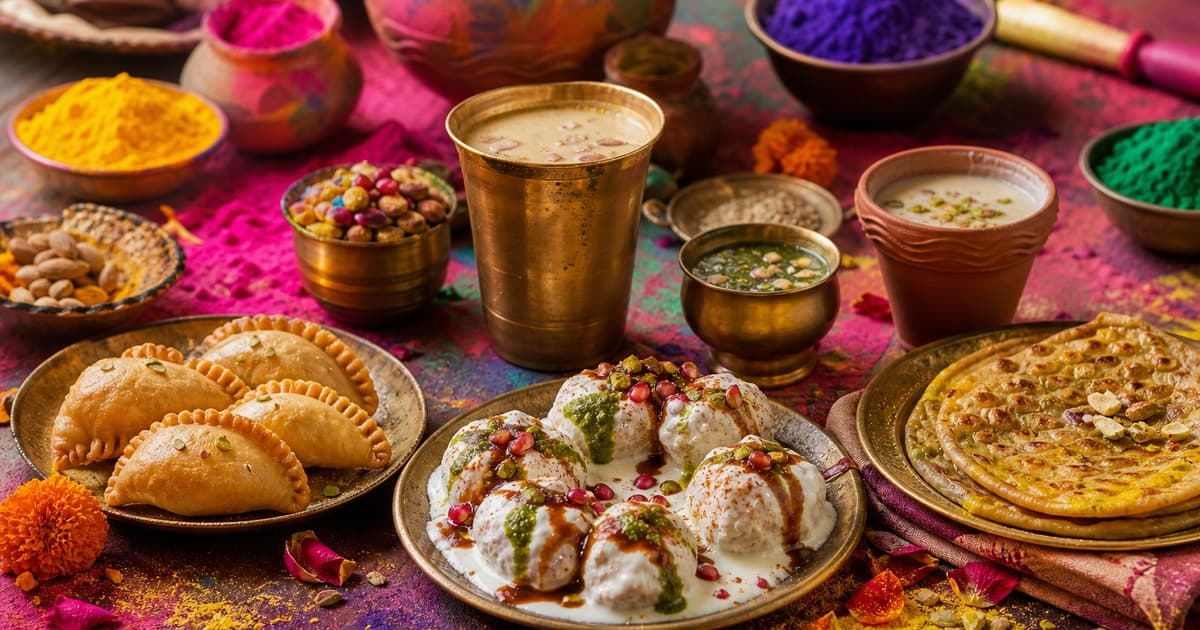
Holi is a springtime feast of color, reunion, and playful hospitality across India, Nepal, and the diaspora. In North India and the Braj region, Gujiya is commonly served as a rich, crisp festival sweet, while chilled Thandai—fragrant with nuts, spices, rose, and sometimes regulated bhang—often cools the day’s color-throwing. Dahi Bhalle brings a savory, yogurt-laced contrast to sweet tables. Regional plates shift with place: Puran Poli is traditionally associated with Maharashtrian Holi, Bengal’s Dol Yatra may bring payesh or mishti, and Nepali Phagu Purnima adds local sweets such as yomari or sel roti.
Signature Dishes
Gujiya
गुजिया
Thandai
ठंडाई
Dahi Bhalle
दही भल्ले
Puran Poli
पुरणपोळी
Bhang
भांग
Regional Variations
Braj (Mathura/Vrindavan/Barsana/Nandgaon)
Most elaborate Holi celebrations; Lath-Mar Holi at Barsana/Nandgaon; Phoolon-Ki-Holi at Banke Bihari Temple; gujiya and thandai canonical.
Bengal/Odisha
Observed as Basanta Utsav (Shantiniketan) and Dol Yatra/Dol Purnima with Krishna idols on swings; payesh, malpua, pithe, and mishti are served.
Maharashtra
Celebrated as Rang Panchami five days after Holika Dahan; puran poli and shrikhand signature; rural Konkan observes Shimga with deity palanquins.
Gujarat
Holika Dahan community bonfires; Rangwali Holi features gujiya, dhokla, and basundi.
Punjab/North-West India
Shares North Indian signatures (gujiya, thandai, malpua); celebrated alongside the distinct Sikh Hola Mohalla observed the day after.
Tamil Nadu/South India
Native South Indian Holi observance is minimal; mainly celebrated by transplanted North Indian communities. Panguni Uthiram is adjacent but distinct.
Nepal
Celebrated as Phagu Purnima, often spanning 2-8 days; Newari sweets like yomari and sel roti commonly served.
Manipur
Celebrated as Yaosang over 5-6 days; blends Hindu Holi with Meitei traditions including Thabal Chongba folk dance under moonlight.
Caribbean diaspora (Trinidad, Guyana, Suriname)
Celebrated as Phagwah, brought by 19th-century indentured laborers; features chowtal singing, pichakaari, and adapted gujiya/malpua/thandai.
South Asian diaspora (UK/US/Canada/Australia/Mauritius/Fiji/South Africa)
Celebrated in temples, community centers, and parks; gujiya, thandai, malpua, dahi vada remain canonical; national observance in Mauritius and Fiji.
Observance Practices
Holika Dahan bonfire on the eve of Holi commemorating Prahlada's protection
Color-throwing with gulal and abeer powders
Dousing with colored water using pichakaari (water guns)
Communal feasts featuring gujiya, thandai, malpua, and dahi vada
Krishna-Radha devotional singing
Braj region and broader North India
Lath-Mar Holi (women playfully striking men with sticks)
Barsana and Nandgaon, Braj
Phoolon-Ki-Holi (flower-only Holi)
Banke Bihari Temple, Vrindavan
Bhang consumption (traditional, regulated, sometimes controversial)
North India
Visiting elders and extended family; forgiveness and reconciliation rituals
Basanta Utsav celebration with Tagore-inspired song and dance
Shantiniketan, West Bengal
Dol Yatra/Dol Purnima — placing Krishna idols on swings
Bengal/Odisha
Rang Panchami observed five days after Holika Dahan
Maharashtra
Shimga palanquin processions of village deities
Rural Maharashtra and Konkan
Thabal Chongba folk dance under moonlight during Yaosang
Manipur
Chowtal devotional singing
Indian-Caribbean diaspora
Regions
Cuisines
Related Recipes
Gulab Jamun (गुलाब जामुन) — Indian Rose-Scented Milk Dumplings in Cardamom Syrup
commonly served·North India, Indian diaspora
Gajar Ka Halwa (गाजर का हलवा) — Indian Grated Carrot Pudding with Cardamom
commonly served·North India
Chole Bhature (छोले भटूरे) — Punjabi Chickpea Curry with Puffy Fried Bread
commonly served·North India, Indian diaspora
Bhel Puri (भेल पूरी) — Indian Puffed Rice Chaat with Tangy Chutneys
commonly served·India, Indian diaspora