Karva Chauth
करवा चौथ
About Karva Chauth
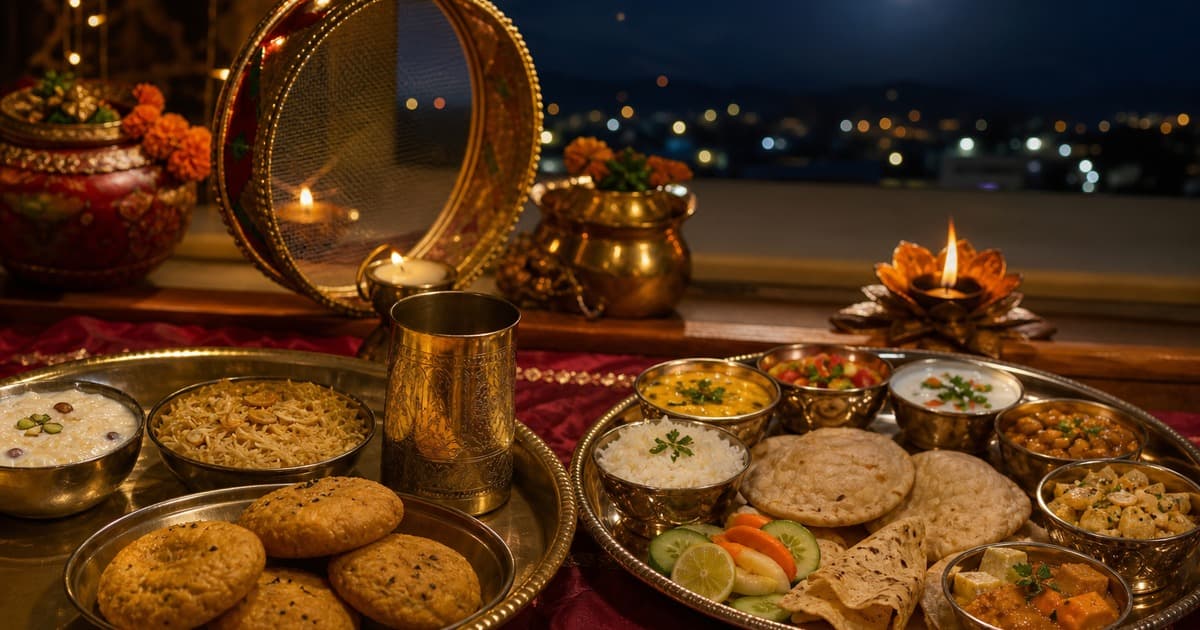
Karva Chauth structures the day around two distinct food moments, bookending a sunrise-to-moonrise fast traditionally observed by married women across North India — Punjab, Haryana, Delhi, Rajasthan, Uttar Pradesh — and within the global North Indian diaspora. In the quiet hours before dawn, the sargi thali arrives, often prepared by a mother-in-law for her daughter-in-law: delicate strands of feniya (pheni), a vermicelli-like sweet eaten with warm milk, alongside flaky mathri, halwa, paranthas, seasonal fruit, and dry fruits — the last nourishment before the nirjala fast begins. After moonrise, when women glimpse the moon through a sieve and the fast is broken with a first sip of water offered by the husband, the evening unfolds into a festive thali feast: kheer, chana, paranthas, paneer preparations, and mithai commonly served to mark the day's completion. Punjabi households tend toward especially elaborate sargi spreads, while diaspora gatherings in the UK, US, and Canada often adapt the Katha circle and thali exchange to community halls and home kitchens.
Signature Dishes
Sargi foods
Feniya / seviyan
Mathri
Kheer
Thali feast after moonrise
Regional Variations
Punjab
Most elaborate observance; Sargi tradition from mother-in-law particularly emphasized; pheni and mathri are signature Punjabi Sargi items.
Haryana
Strict nirjala fast commonly observed; community Katha gatherings prominent; similar ritual structure to Punjabi tradition.
Delhi
Urban observance blending Punjabi and UP traditions; Bollywood-influenced styling and mehendi gatherings widespread.
Uttar Pradesh
Katha recitation centered on Queen Veervati legend; thali-passing among 7 women commonly practiced.
Madhya Pradesh
Observed by married Hindu women with regional adaptations; festive thali post-moonrise.
Rajasthan
Observed with regional bridal attire (lehenga, odhni); some overlap with local Karwa Chauth folk songs.
Gujarat
Observed by North Indian-origin and some Gujarati Hindu communities; less universal than in Punjab/Haryana.
Sindhi community
Observed with modifications fitting Sindhi religious framework; not universal across all Sindhi households.
Indian diaspora (UK, US, Canada, Australia, Singapore)
North Indian Hindu diaspora gatherings; community Katha at temples or homes; moonrise timing adjusted to local sky.
Observance Practices
Sargi pre-dawn meal (~3-5 AM) traditionally given by mother-in-law, containing pheni, sweets, dry fruits, paranthas, mathri, halwa, fruits
North India, especially Punjab
Daylong nirjala fast from sunrise to moonrise (no food, no water); modern variants may permit water
Mehendi (henna) application on hands the day before
Solah Shringar — 16 traditional bridal adornments including bindi, sindoor, mangalsutra, bangles
Afternoon Karva Chauth Katha gathering with recitation of Queen Veervati / Karva legend
Karva (clay pot) exchange and decorated thali passed in a circle among 7 women
North India
Viewing the moon through a sieve (chalni), then viewing husband's face through it at moonrise
Husband offers first sip of water and first bite of food to wife to break the fast
Festive North Indian post-fast thali (chana masala, paranthas, dal makhani, saag-paneer, pulao, sweets)
North India
Husband-wife gift exchange following fast-breaking
Modern solidarity practice: some husbands fast alongside wives
urban India and diaspora
Observance by engaged/unmarried women for prospective husbands (modern adaptation)
Regions
Cuisines
Related Recipes
Aloo Paratha (आलू पराठा) — Indian Potato-Stuffed Breakfast Flatbread
commonly served·North India
Amritsari Kulcha (अमृतसरी कुलचा) — Tandoor-Baked Stuffed Leavened Bread
commonly served·Punjab, North India
Chana Masala (चना मसाला) — Indian Spiced Chickpea Curry with Tomato and Onion
commonly served·North India
Dal Makhani (दाल मखनी) — Indian Slow-Cooked Black Lentils with Cream and Butter
commonly served·Punjab, North India
Gajar Ka Halwa (गाजर का हलवा) — Indian Grated Carrot Pudding with Cardamom
commonly served·North India