Moroccan Eid al-Fitr
About Moroccan Eid al-Fitr
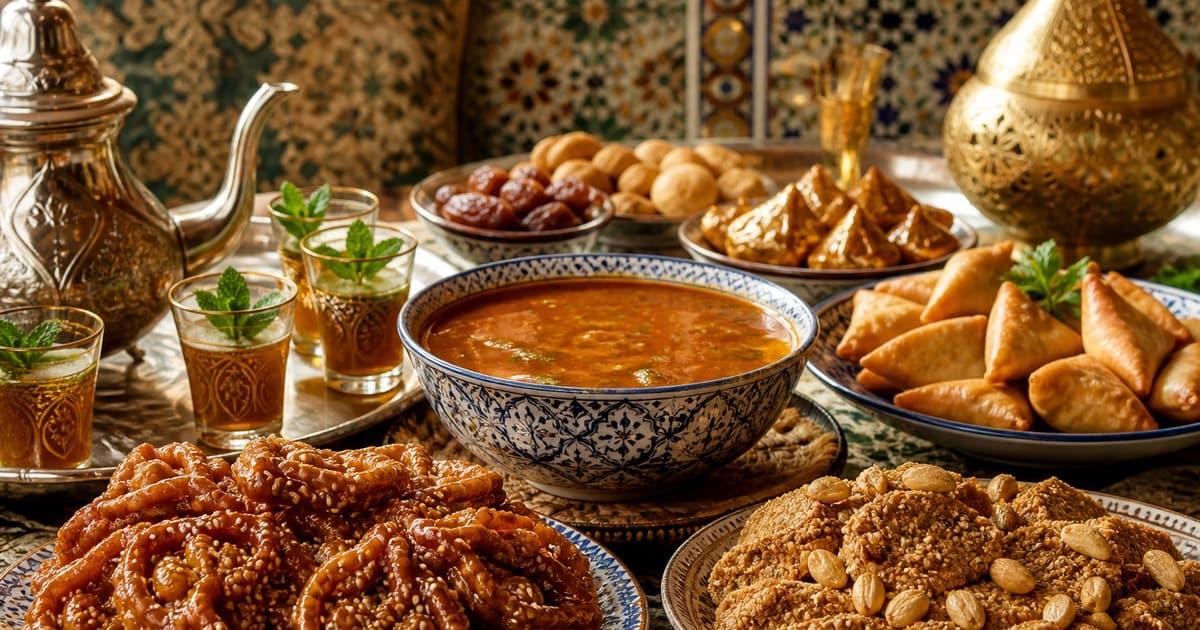
Moroccan Eid al-Fitr unfolds as a distinctly Maghrebi celebration shaped by days of preparation and the warm hum of open houses. In the final week of Ramadan, women and extended family gather to fold and fry Chebakia, the sesame-and-honey flower-shaped pastry often prepared in kilos and stacked for guests, while Sellou — an unbaked confection of toasted flour, sesame, almonds, butter and honey — is pressed into bowls as an energy-rich welcome sweet. On Eid morning, after Salat al-Eid, families commonly share Harira, the lentil-tomato-meat soup carried over from Ramadan, alongside almond-stuffed Briouats and glasses of Moroccan Mint tea (Atay bil Naha) poured ceremonially throughout the day. Regional textures deepen the table: imperial cities like Fes and Meknes are known for refined Kaab el-Ghazal and elaborate Chebakia, Marrakchi households lean into Harira Marrakchia and Mrouzia, while Amazigh communities in the Atlas, Rif, and Sous regions weave in argan oil, Aghroum breads, and Berber-Imazighen sweet traditions.
Signature Dishes
Chebakia
Sellou
sfouf
Harira
Briouats
Mint tea
Regional Variations
Fes / Meknes (Imperial Cities)
Refined imperial-court sweet-making traditions; elaborate Chebakia and Kaab el-Ghazal preparations rooted in Andalusian-Moroccan heritage.
Marrakech / Atlantic Coast
Marrakchi variations of Harira and Mrouzia; some Atlantic coastal communities incorporate seafood in Eid meals.
Atlas Mountains (Amazigh Imazighen)
Berber-influenced Eid featuring traditional Imazighen breads like Aghroum; mountain-community-specific tagines.
Rif Mountains (Riffi Amazigh)
Distinctive Riffi sweet preparations reflecting joint Imazighen and Arabic-Muslim heritage of the northern region.
Sous Region (Soussi Amazigh)
Soussi-distinct Eid sweets often featuring argan oil incorporated into cooking and confections.
Sahrawi / Saharan Moroccan
Saharan Eid traditions with centrality of tea-making ritual and desert-community observances.
Moroccan Diaspora (Belgium, Netherlands, France, Spain, Canada, US)
Diaspora communities in Brussels, Amsterdam, Paris, Madrid, Montreal maintain Chebakia tradition and community Eid gatherings.
Observance Practices
Pre-Eid Chebakia preparation; women and extended family gather for multi-day cooking, often producing 5-10kg per household.
Sellou/Sfouf and Briouats prepared in advance during last week of Ramadan.
Eid morning Salat al-Eid communal prayer at mosque.
Family hierarchy visits: youngest visits eldest first; Eidiya gifts given to children.
Eid breakfast traditionally featuring Harira, Sellou, Chebakia, and Moroccan mint tea (Atay bil Naha).
Henna application for women and girls (Hennaya tradition).
Sweet distribution to neighbors as community-bonding custom.
Continuous ceremonial service of Moroccan mint tea throughout Eid days.
Multi-day Eid celebration (3 days primary; some communities extend up to 7).
Wearing new traditional Moroccan attire: kaftan for women, jellaba for men.
Seksou (couscous) with seven vegetables and Tfaya (caramelized onion-raisin) topping commonly served as Eid centerpiece.
Mrouzia (slow-cooked lamb with honey, raisins, almonds) traditionally associated with Maghrebi Eid feasting.
Pastilla/B'stilla often prepared as special-occasion sweet-savory dish.
Berber-influenced Eid observances with traditional Imazighen breads (Aghroum).
Atlas Mountains / Rif / Sous Amazigh regions
Argan oil incorporated in Eid cooking and sweet-making.
Sous Region
Tea-making ritual as central observance element.
Sahrawi / Saharan Moroccan
Traditional Moroccan music and Mawazine-style musical traditions during celebration.
Regions
Cuisines
Related Recipes
Chebakia (الشباكية) — Moroccan Sesame and Honey Cookie Roses
signature·Morocco
Briouats (بريوات) — Moroccan Crispy Phyllo Triangles with Spiced Lamb
signature·Morocco
Harira Marrakchia (حريرة) — Moroccan Lamb and Chickpea Soup
commonly served·Morocco
Harira (الحريرة) — Moroccan Tomato and Lentil Ramadan Soup
regional variant·Morocco
Briouat with Almonds (بريوات باللوز) — Moroccan Sweet Almond and Honey Phyllo Triangles
regional variant·Morocco