Ramadan Desserts
شیرینیهای ماه رمضان
About Ramadan Desserts
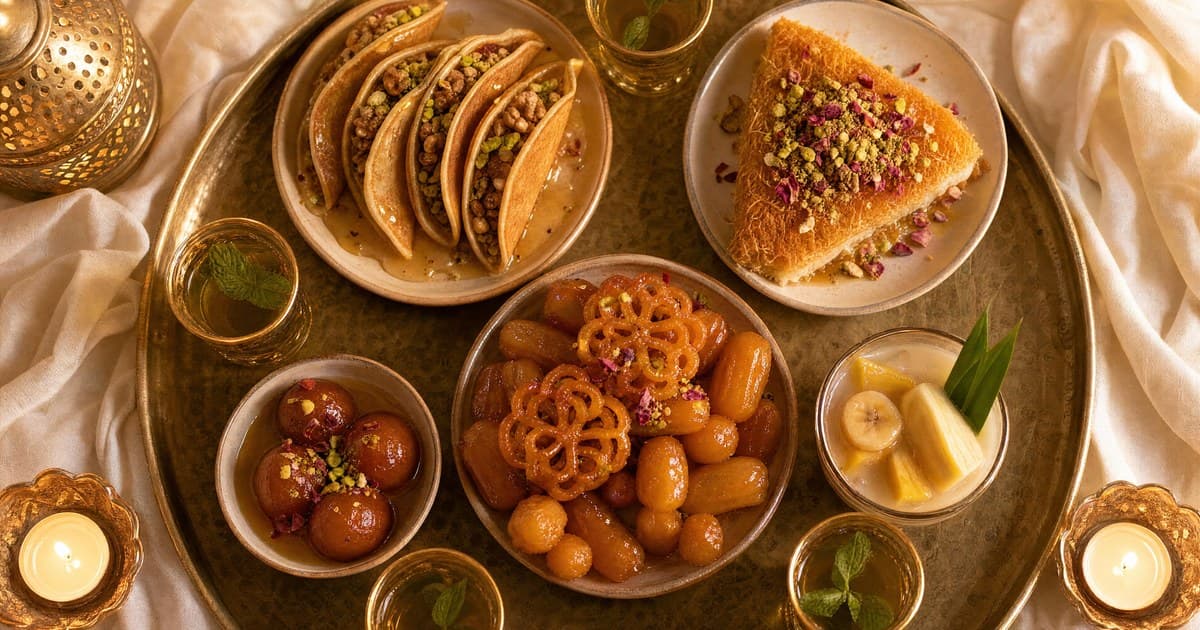
Ramadan desserts are the heart of Iftar after the main meal — the night-after-the-fast that families savor with mint tea, sherbet, or coffee, often gathering past 10 PM as the long night unfolds before Suhoor. Across the Muslim world, each tradition has a signature sweet that becomes Ramadan-specific: Levantines fold Qatayef pancakes around walnuts or sweet cheese and fry them in sugar syrup; Arabs from Egypt to Palestine layer Kunafa with cheese or cream and douse it in attar syrup; Iranians fry Zoolbia (golden flower-shaped funnel pastries) and Bamieh (small finger-shaped doughnuts) in saffron-rose syrup; South Asians serve warm Gulab Jamun in cardamom syrup or sweet vermicelli Sheer Khurma; Indonesians ladle Kolak (sweet banana-and-jackfruit in coconut-pandan syrup); Turks fold Güllaç roses of rose-milk sweet wafers, and pour Baklava in date-palm syrup variations. This page maps the Ramadan-specific dessert traditions of the global Ummah — recognizing that the spiritual fast ends at sunset but the celebration extends into the night, and the dessert often becomes the most family-defining part of the daily rhythm.
Signature Dishes
Qatayef (Levantine)
قطايف
Kunafa (Arab)
كنافة
Zoolbia Bamieh (Persian)
زولبیا بامیه
Gulab Jamun (South Asian)
گلاب جامون
Kolak (Indonesian)
کولاک
Regional Variations
Levantine (Lebanese / Syrian / Palestinian / Jordanian)
Qatayef are the iconic Ramadan pancake: small thick crêpes folded around walnuts (and sometimes pine nuts) or sweet ashta cream, then fried and dipped in qatr (attar-rose syrup). Kunafa (knafeh) layered with akkawi cheese or sweet cream, baked in samneh, and drowned in attar syrup. Maamoul stuffed-date and pistachio cookies often appear pre-Eid.
Egyptian / Sudanese
Kunafa with cream (Konafa bil Ashta) or with cheese (Konafa bil Jibna), Qatayef Asafiri (small open-fold), Basbousa (semolina syrup cake), Om Ali (bread pudding with milk and nuts), Atayef Saghira deep-fried mini-folds. Sudanese Aseeda with sweet syrup.
Persian / Iranian / Afghan
Zoolbia-Bamieh duo iconic: Zoolbia are golden flower-shaped pretzel-style funnel pastries fried in oil and saturated with saffron-rose syrup; Bamieh are small finger-shaped doughnuts in the same syrup. Sholeh Zard (saffron rice pudding) and Ferni (rice-flour pudding) common. Afghan Firnee/Sheer Birinj similar. NOT to be confused with Bamieh okra stew (homophone).
South Asian (Pakistani / Indian Muslim / Bangladeshi)
Sheer Khurma (sweet vermicelli with milk, dates, and dry fruits) is the iconic Ramadan and Eid dessert. Gulab Jamun (rose-cardamom milk dumplings in sugar syrup) hot and warming for Iftar. Jalebi pretzels in syrup, often served alongside rabri (thickened milk). Falooda (vermicelli-rose-milk dessert) common.
Indonesian / Malaysian
Kolak (sweet banana, jackfruit, sweet potato, or palm-sugar fruits cooked in coconut milk and pandan syrup) is the iconic Ramadan dessert. Es Buah (mixed fruit cocktail in syrup with shaved ice). Bubur Sumsum (sweet rice porridge with palm sugar). Onde-Onde (palm-sugar-stuffed glutinous rice balls).
Turkish / Balkan Muslim
Güllaç (rose-water-and-milk-soaked sweet pastry wafers stuffed with nuts and pomegranate) is exclusively Ramadan-specific in Turkey. Pide bread also seasonal. Baklava in many regional variants. Aşure (Noah's Pudding) appears on 10 Muharram (Ashura) but Ramadan also features it.
Moroccan / Maghrebi
Chebakia (rose-shaped sesame-honey-saffron deep-fried cookies) is iconic Ramadan. Sellou (Sfouf — toasted flour, almonds, sesame, honey energy confection — for breaking fast). Mhannchas (almond-paste-stuffed serpent pastry). M'hencha. Briouats (sweet phyllo triangles with almond-paste filling).
Sub-Saharan African (Somali / Senegalese / Nigerian)
Cambuulo with sugar and ghee Somali. Lakh (millet porridge with yogurt and date paste) Senegalese. Masa (sweet rice cakes) Nigerian Hausa-Fulani. Sesame-honey balls common across Sahel.
Iraqi / Gulf (Saudi / Emirati / Kuwaiti / Qatari)
Qatayef with kushkak (sweet ashta-and-pistachio filling), Mahalabia (rose-water milk pudding), Luqaimat (sweet fried dough balls in saffron-cardamom syrup) — the iconic Gulf Ramadan dessert. Date-stuffed Ma'amoul.
Observance Practices
Most Ramadan desserts are served 1-2 hours after the main Iftar meal, often after Taraweeh prayers (~9-10 PM), accompanied by mint tea, Arabic coffee, or sherbet drinks
Dessert tradition is deeply family-defining: the grandmother's Qatayef recipe, the mother's Zoolbia frying technique, the father's Kunafa shop visit — these are mnemonic-cultural anchors
Some desserts are RAMADAN-NIGHT specific (Qatayef, Güllaç, Zoolbia-Bamieh, Kolak, Luqaimat); others are EID-specific (Ma'amoul, Sheer Khurma in some traditions, Kahk)
Sunni, Shia, Sufi, Wahhabi, and Salafi communities all share dessert traditions; sweets are regional/cultural not sectarian
Sweets are commonly shared with neighbors, mosque iftar tables, and the poor (sufrat-al-rahmah / dastarkhwan tradition); distributing desserts to children of the neighborhood is Sunnah-aligned