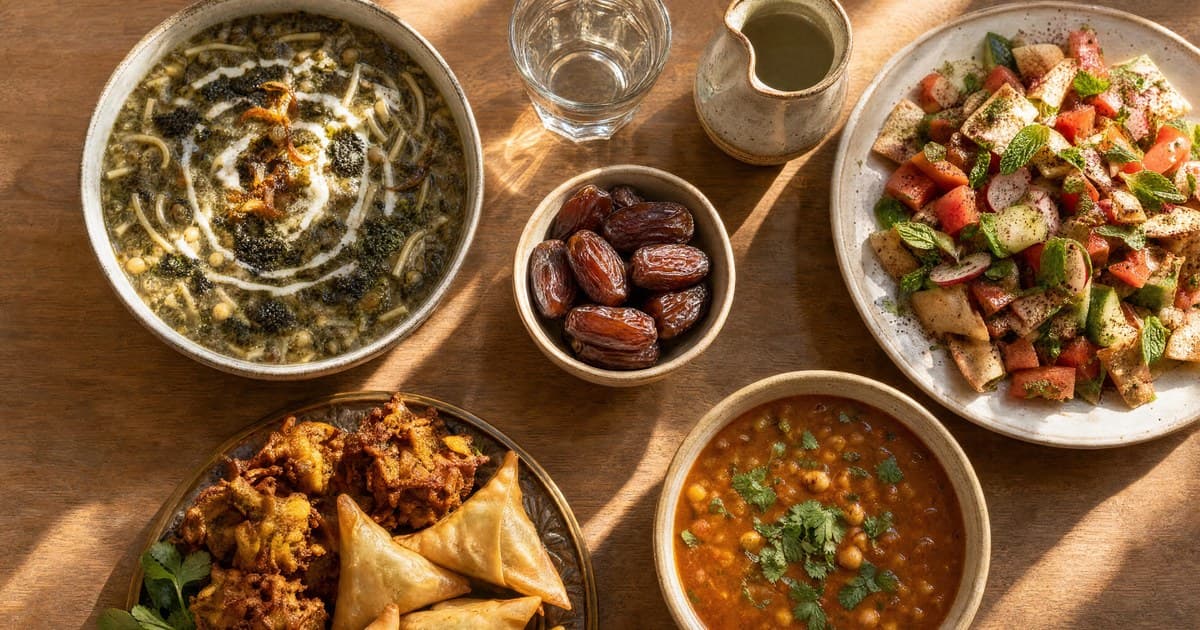
Ramadan Iftar Essentials
افطاریهای ماه رمضان
About Ramadan Iftar Essentials
Iftar is the meal that breaks the daily Ramadan fast at sunset, opening with a few dates and water following the Sunnah of Prophet Muhammad ﷺ, and unfolding into a deeply regional spread that crosses Muslim communities from Marrakesh to Mindanao. While the spiritual framework is shared — gratitude, family, prayer, and the immediate post-Maghrib gathering — the food itself is unapologetically local: Moroccans break the fast with Harira, Iranians with Ash Reshteh and dates, Lebanese and Syrians with Fattoush and Lentil Soup, Egyptians with Koshary and dates, South Asians with Pakoras, Samosas and Rooh Afza, Indonesians and Malays with kolak and bubur lambuk. This page is a global Iftar reference: not one tradition's table imposed on all, but a respectful cross-section that lets each family find both their own and discover others. Fasting-breaking-fast practice spans all Muslim sub-traditions (Sunni / Shia / Sufi / Wahhabi / Salafi) with shared dates-and-water Sunnah opening; the dishes that follow are regional, not sectarian.
Signature Dishes
Dates (breaking fast)
خرما
Ash Reshteh (Persian)
آش رشته
Harira (Moroccan)
حريرة
Pakora/Samosa (South Asian)
پکوره/سمبوسه
Fattoush (Levantine)
فتوش
Regional Variations
Persian / Iranian
Iftar opens with dates and water following Sunnah, then Ash Reshteh (herb-and-noodle soup) or Ash-e-Doogh (yogurt-and-herb soup), Adasi (lentil stew), Noon-o-Panir-o-Sabzi (flatbread-cheese-herbs platter), Sholeh Zard (saffron rice pudding) to finish. Tea throughout.
Afghan
Dates and water, then Bolani (stuffed flatbread), Mantu (steamed dumplings), Aush (noodle soup with yogurt and mint), kebab platters, fresh greens, and Firni (rice-flour pudding) at close. Strong overlap with Persian tradition; Tajik-Persian-language community shares core framework.
Moroccan / Maghrebi
Iconic Harira (tomato-lentil-chickpea-lamb soup) opens Iftar across Morocco, Algeria, Tunisia, Libya. Chebakia (sesame-honey pastries), Briouats (savory pastries), dates, milk, Sellou (toasted flour confection for energy), Mint tea. Distinct Moroccan Ramadan table identity.
Egyptian
Dates and water, Koshary (rice-lentil-pasta-tomato), Foul (fava bean stew with cumin and lemon), Mahshi (stuffed vegetables), Konafa with cream and nuts, Qatayef stuffed with sweet cheese, Tamarind and Karkadeh (hibiscus) drinks.
Levantine (Lebanese / Syrian / Jordanian / Palestinian)
Fattoush (toasted pita salad with sumac) and Tabbouleh herald the Iftar, alongside Adas Soup (lentil with cumin), grilled meats, Kibbeh, Hummus and Mutabal and Labneh and Olive oil mezze platter, Maamoul and Qatayef desserts.
Iraqi
Tashreeb (lamb-and-bread stew), Margat Bamia (okra-lamb stew), Quzi (whole-lamb-with-rice), date-based desserts.
Turkish
Maghreb call to prayer breaks fast; Pide (Ramadan flatbread) is iconic and seasonal-specific. Mercimek çorbası (red-lentil soup), Içli köfte (stuffed bulgur kibbeh), grilled meats, Güllaç (rose-water-milk dessert layered with sweet pastry) signature.
South Asian (Pakistani / Indian Muslim / Bangladeshi)
Pakora (vegetable fritters), Samosa (spiced potato-pea pastry), Chana Chaat (chickpea salad), Dahi Phulki, Haleem (slow-cooked wheat-and-meat porridge), Jalebi, Rooh Afza rose syrup drink, lassi.
Indonesian / Malaysian
Kolak (sweet coconut-milk fruit compote), Bubur lambuk (rice porridge with spices and meat), Es Buah (mixed fruit cocktail in syrup), Kurma (dates), Lontong/Ketupat with sayur lodeh.
Filipino Muslim (Bangsamoro / Mindanao)
Pastil (rice with seasoned chicken wrapped in banana leaf), Tiyula Itum (black soup with charred coconut), date breakers, halal Filipino-Tausug Sulu specialties.
Sub-Saharan African (Somali / Sudanese / Nigerian)
Cambuulo (mung bean stew) and Anjeero (sourdough flatbread) Somali; Aseeda and Mulah Rob (yogurt stew) Sudanese; Suya (spiced grilled beef skewers) Nigerian Hausa-Fulani.
Central Asian (Uzbek / Tajik / Kazakh)
Plov (rice with meat and carrots) anchors many Central Asian Iftar tables; manty (steamed dumplings), shashlik, samsa pastries, Choy (tea) ceremony at close. Tajik tradition shares Persian-language root.
Observance Practices
Iftar opens with Maghrib call to prayer following sunset; Sunnah practice begins with odd number of dates (3, 5, or 7) and water, followed by Maghrib prayer, then the main meal
Sunni, Shia, Sufi, Wahhabi, and Salafi communities all practice Iftar with shared Sunnah-of-dates opening; the food that follows is regional/cultural, not sectarian
Communal practice — family gathering, mosque iftar tables, charity tables (sufrat-al-rahmah in Egypt, dastarkhwan in South Asia), iftar invitations to neighbors and travelers
Recommended dua at breaking fast: ذهب الظمأ وابتلت العروق وثبت الأجر إن شاء الله ('The thirst is gone, the veins are moistened, and the reward is established by the will of Allah')
Iftar-Suhoor cycle is the core Ramadan rhythm; the fast (Sawm) is broken at sunset and pre-dawn meal (Suhoor) marks the start of the next day's fast
Avoid overindulgence — the spiritual purpose is gratitude and moderation, not feasting
Regions
Cuisines
Related Recipes
Pakora (پکوڑا) — Indian Crispy Vegetable Fritters
signature·South Asia
Ash Reshteh (آش رشته) — Persian Herb, Bean, and Noodle Soup
signature·Iran
Harira (الحريرة) — Moroccan Tomato and Lentil Ramadan Soup
signature·Morocco
Fattoush (فتوش) — Lebanese Toasted Pita Salad with Sumac Dressing
signature·Lebanon
Samosa (समोसा) — Indian Crispy Spiced Potato and Pea Pastry
signature·South Asia