Sri Lankan Sinhala and Tamil New Year
Aluth Avurudda/Puthandu
About Sri Lankan Sinhala and Tamil New Year
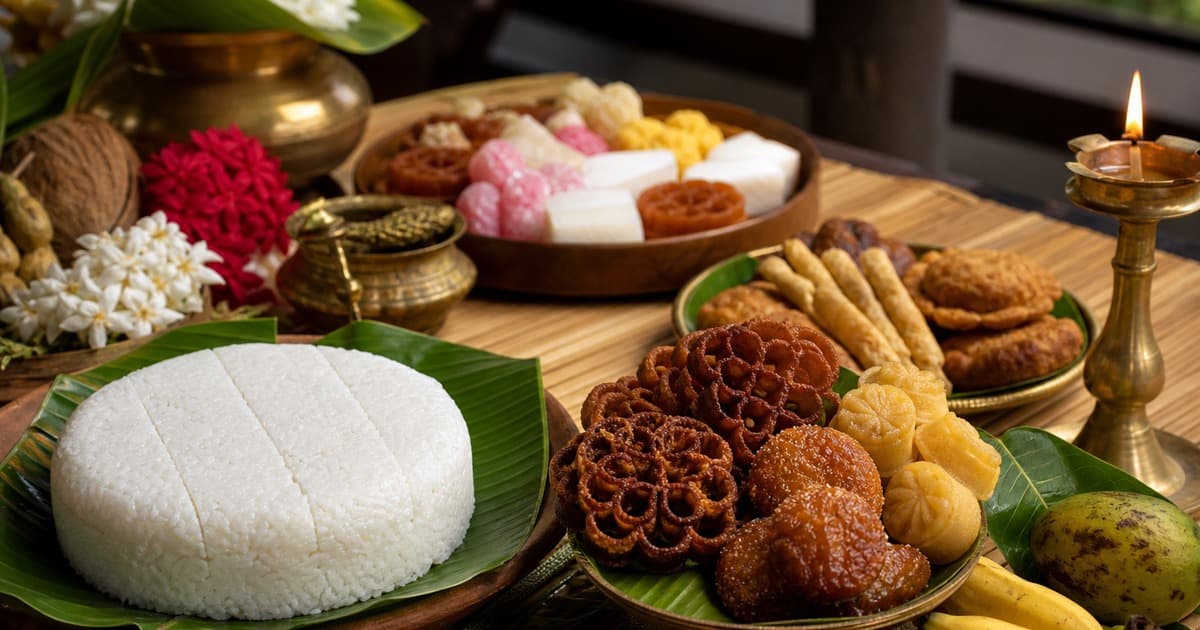
The Sinhala and Tamil New Year (Aluth Avurudda / Puthandu), commonly observed across Sri Lanka on 13–14 April, is a shared solar festival marking the Sun's transition into Aries — celebrated distinctly yet side-by-side by the Sinhalese Buddhist majority and the Sri Lankan Tamil Hindu community. In Sinhalese homes, the first meal of the new year is traditionally Kiribath, coconut-milk rice cut into diamond shapes and cooked at the auspicious nekath time, served alongside trays of golden Kavum (treacle-soaked oil cakes with their signature twisted crowns), lacy flower-shaped Kokis with a Dutch-heritage crunch, and Mung kavum stuffed with sweetened mung bean. An Avurudu sweet assortment — often including aluwa, athirasa, and aasmi — circulates between visiting relatives. In Sri Lankan Tamil households, the table often carries Maanga Pachadi, a six-taste raw-mango chutney symbolic of the year's varied emotions, with vadai, murukku and payasam. Across both traditions, food is timed to astrology, anchored in family, and shared generously across community lines.
Signature Dishes
Kiribath
කිරිබත්
Kokis
කොකිස්
Kavum
කවුම්
Mung kavum
Avurudu sweet assortment
Regional Variations
Sinhalese Buddhist (island-wide Sri Lanka)
Aluth Avurudda anchored by Nekath (auspicious times), Nonagathaya transition, kiribath cooked at precise auspicious moment, kavum/kokis/aluwa sweets, Hisa Thel Gama oil-anointing.
Sri Lankan Tamil Hindu (Jaffna, Northern Province)
Puthandu observed with Kanni auspicious viewing at sunrise, temple visit, kolam at doorways, Maanga Pachadi six-taste tasting; distinct from South Indian Tamil practice.
Sri Lankan Tamil Hindu (Eastern Province — Batticaloa, Trincomalee)
Puthandu shares core Tamil rituals with Northern Province but with Eastern Sri Lankan Tamil culinary inflections and temple-festival customs.
Up-Country Tamil (Hill Country / Plantation Tamil)
Puthandu observed within plantation Tamil communities of Nuwara Eliya/Hatton region; estate-community gatherings, temple visits, more modest household rituals.
Sri Lankan Sinhalese diaspora (UK, Canada, Australia, Italy)
Community Aluth Avurudda gatherings via Buddhist viharas and Sinhalese associations; kiribath and kavum prepared; Nekath observance flexed around local timezones and work calendars.
Sri Lankan Tamil diaspora (Canada–Toronto, UK, Switzerland, Norway, Germany, Australia)
Community Puthandu celebrations at Sri Lankan Tamil Hindu temples (e.g., Toronto Murugan temples); kanni, kolam, and Maanga Pachadi maintained; distinct from Indian Tamil diaspora events.
Observance Practices
Consulting Nekath (astrologically determined auspicious times) for each ritual moment
Sinhalese Buddhist
Old Year closing rituals — oil lamps, bathing, sweeping the home (Parana Avurudda Mangallaya)
Sinhalese Buddhist
Nonagathaya — transitional no-work period between old and new year, reserved for religious activity
Sinhalese Buddhist
Cooking kiribath (coconut milk rice) at the auspicious Nekath time as the first food of the new year
Sinhalese Buddhist
First family money transactions (Hindu Vyaparaya Mangallaya) at auspicious time
Sinhalese Buddhist
Hisa Thel Gama — senior family member anoints heads of younger members with oil at auspicious time
Sinhalese Buddhist
Wearing color-of-the-year clothing as prescribed by the year's astrological reading
Sinhalese Buddhist
Exchanging trays of kavum, kokis, aluwa, and aasmi with neighbors and relatives
Sinhalese Buddhist
Traditional Avurudu village games and sports (pillow fights, kotta pora, climbing greased pole)
Sinhalese Buddhist (rural and community festivals)
Kanni — sunrise viewing of auspicious arrangement (gold, rice, flowers, lit lamp, new clothes, religious icon)
Sri Lankan Tamil Hindu
Hanging mango leaf toranam and drawing kolam (rice-flour designs) at doorways
Sri Lankan Tamil Hindu
Temple visit with sandalwood-paste forehead marking
Sri Lankan Tamil Hindu
Preparing and tasting Maanga Pachadi — six-taste raw mango chutney symbolizing the year's varied experiences
Sri Lankan Tamil Hindu
Family meal with traditional dishes — payasam, vadai, murukku, kesari, vellai pongal
Sri Lankan Tamil Hindu
Visiting elders and extended relatives, offering respect and receiving blessings
Wearing new clothes for the new year
Observance as a Sri Lankan national public holiday (April 13–14)
Regions
Cuisines
Related Recipes
Aromatic Coconut Chicken Curry Soup (سوپ کاری مرغ با نارگیل) — Velvety coastal-style coconut curry broth
commonly served·Sri Lankan coconut-curry tradition
Appam with Stew (അപ്പം & ഇഷ്ടു) — Lacy rice pancakes with coconut vegetable curry
regional variant·Sri Lankan Tamil + Sinhalese (shared with Kerala adjacency)
Chettinad Chicken (செட்டிநாடு கோழி குழம்பு) — Peppery roasted-spice chicken curry from Tamil Nadu
regional variant·Sri Lankan Tamil (Tamil culinary tradition shared)
Avial (അവിയൽ) — Kerala mixed vegetables in coconut-yogurt gravy
regional variant·Sri Lankan Tamil + Kerala adjacency