Shakarob (Шакароб) — Tajik Tomato-Onion Bread Salad
Shakarob is a Tajik summer bread salad made with juicy tomatoes, onion, herbs, and torn fatir or non. Unlike qurutob, it relies on salted tomato juices rather than qurut, making it lighter and bright.
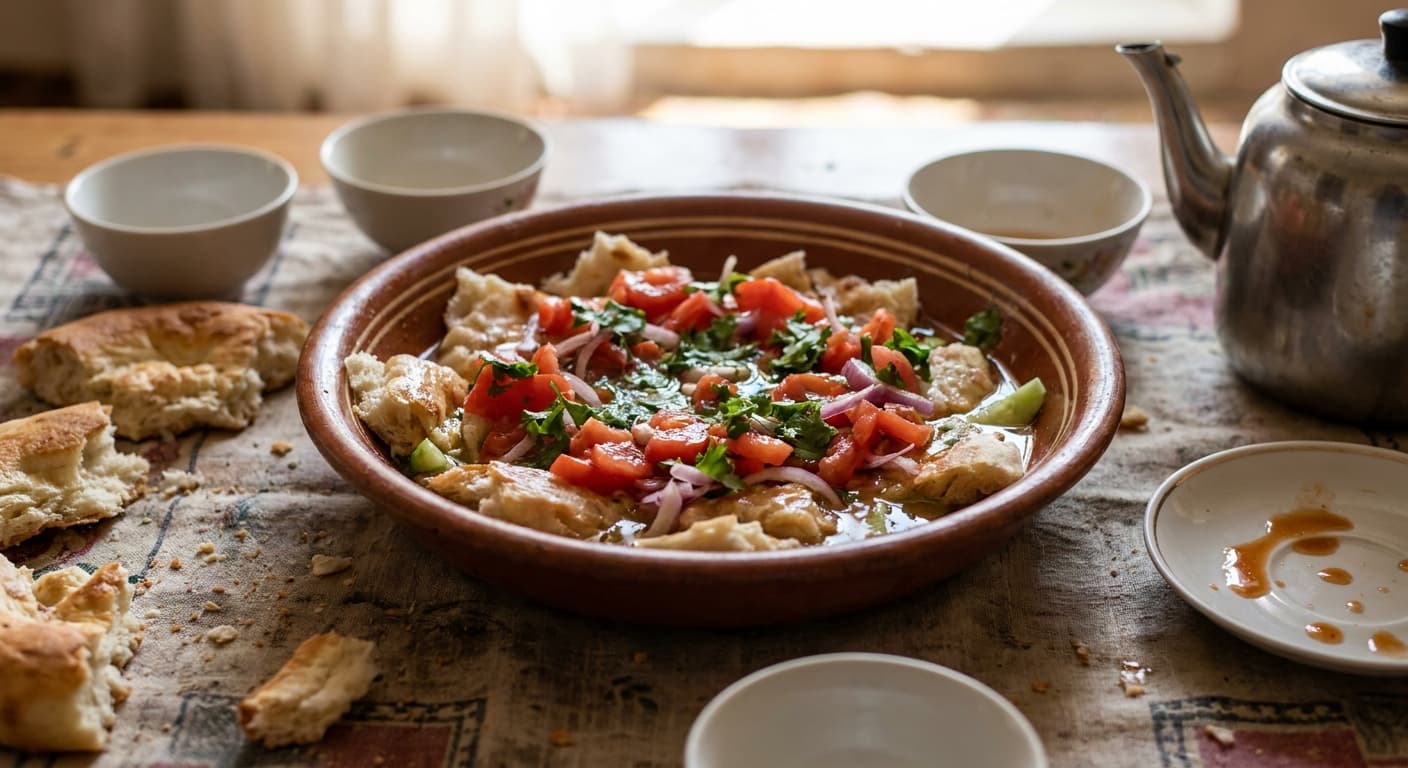
Printable Recipe Card
Servings: 4 · Total: 25 min · Difficulty: easy
Ingredients (quick list)
- 300 g plain fatir flatbread (torn into bite-size pieces; Tajik non may be used if fatir is unavailable)
- 650 g ripe tomatoes
- 160 g red onion (very thinly sliced)
- 180 g seedless cucumber (halved lengthwise and thinly sliced)
- 0.5 bunch fresh cilantro (leaves and tender stems chopped)
- 0.25 bunch fresh dill (fronds chopped)
- 8 g fine sea salt
- 2 g ground black pepper
- 30 ml sunflower oil
- 60 ml boiled and cooled water
- 10 ml grape vinegar (use mild vinegar, not strongly distilled vinegar)
Steps (summary)
- Warm the fatir in a dry pan over medium heat for 2 minutes per side, just until it smells toasted and bends without cracking. T…
- Put the sliced red onion in a mixing bowl with 3 g of the salt and 20 ml of the boiled and cooled water. Massage the onion for…
- Cut the tomatoes into 2 cm chunks directly over the onion bowl so none of the juice is lost. Add the cucumber, the remaining 5…
- Let the tomato mixture stand for 5 minutes, which is the key technique that creates the watery tomato-onion broth for shakarob.…
- Spoon the tomato, onion, cucumber, herbs, and all the collected juices over the torn fatir. Wait 3 minutes before serving so so…
- Bring the bowl to the table immediately and serve from the center of the dastarkhan with a large spoon. If using Tajik non inst…
Cultural Background
Shakarob reflects Tajik bread-centered hospitality, where fatir or non turns a simple tomato salad into a shared meal. Caroline Eden's work on Samarkand table culture echoes this everyday Central Asian generosity.
Equipment
💡 Tips
- Use the ripest tomatoes available because their juice is the main dressing, not a garnish.
- Slice the onion as thinly as possible; thick onion slices overpower the gentle tomato broth.
- Do not soak the bread for more than 5 minutes before serving, or the salad will lose its pleasing contrast of juicy and chewy textures.
⚠️ Common Mistakes
❌ Adding the bread too early
✅ Fix: Combine bread and tomato juices only 3 to 5 minutes before serving so the pieces soften without collapsing.
❌ Using firm, underripe tomatoes
✅ Fix: Choose heavy, fragrant tomatoes and let them stand with salt for the full 5 minutes to draw out enough juice.
❌ Overdressing with oil
✅ Fix: Keep the sunflower oil to 30 ml so the salad remains a bright tomato-onion broth rather than an oily chopped salad.
🧊 How to Store
Shakarob is best eaten immediately after the bread meets the tomato juices. Store salad and bread separately for up to 24 hours in the refrigerator, then warm the bread briefly and combine just before serving.
📅 Make Ahead
Slice the onion, wash the herbs, and tear the fatir up to 4 hours ahead. Cut and salt the tomatoes no more than 15 minutes before serving so their juice stays fresh.
🍽️ Pairs Well With
- Green tea
- grilled lamb skewers
- shurbo
- fresh fruit
- extra Tajik non.
Regional Variations
- In Dushanbe homes, cucumber and dill are common in warm weather for a cooler, greener shakarob.
- In mountain villages, day-old non may replace flaky fatir because it absorbs tomato juice while still holding its shape.
- Some families serve a spoonful of chakka on the side for a tangy accent, making the bowl feel closer to qurutob without adding qurut.
Ingredients
- 300 gplain fatir flatbread (torn into bite-size pieces; Tajik non may be used if fatir is unavailable)
- 650 gripe tomatoes
- 160 gred onion (very thinly sliced)
- 180 gseedless cucumber (halved lengthwise and thinly sliced)
- 0.5 bunchfresh cilantro (leaves and tender stems chopped)
- 0.25 bunchfresh dill (fronds chopped)
- 8 gfine sea salt
- 2 gground black pepper
- 30 mlsunflower oil
- 60 mlboiled and cooled water
- 10 mlgrape vinegar (use mild vinegar, not strongly distilled vinegar)
🔄 Substitutions
- plain fatir flatbread→ Tajik non or unsweetened round flatbread
- grape vinegar→ fresh lemon juice
- fresh cilantro→ flat-leaf parsley
Instructions
- 1
Warm the fatir in a dry pan over medium heat for 2 minutes per side, just until it smells toasted and bends without cracking. Tear it into bite-size pieces and spread the pieces in a wide shallow serving bowl, leaving them uncovered so they stay slightly crisp while you prepare the salad.
- 2
Put the sliced red onion in a mixing bowl with 3 g of the salt and 20 ml of the boiled and cooled water. Massage the onion for 1 minute with clean fingertips, then let it stand for 10 minutes so its sharpness softens and its juices become part of the shakarob dressing.
- 3
Cut the tomatoes into 2 cm chunks directly over the onion bowl so none of the juice is lost. Add the cucumber, the remaining 5 g salt, the black pepper, the grape vinegar, the sunflower oil, and the remaining 40 ml water, then fold everything together gently.
- 4
Let the tomato mixture stand for 5 minutes, which is the key technique that creates the watery tomato-onion broth for shakarob. Stir in the cilantro and dill only after the tomatoes have released their juice, so the herbs stay fresh and green.
- 5
Spoon the tomato, onion, cucumber, herbs, and all the collected juices over the torn fatir. Wait 3 minutes before serving so some bread softens like qurutob while some edges remain chewy and distinct.
- 6
Bring the bowl to the table immediately and serve from the center of the dastarkhan with a large spoon. If using Tajik non instead of fatir, add it at the last moment because non absorbs the tomato juices faster and can become too soft.
🪪 Recipe Passport
Cultural Background
Shakarob reflects Tajik bread-centered hospitality, where fatir or non turns a simple tomato salad into a shared meal. Caroline Eden's work on Samarkand table culture echoes this everyday Central Asian generosity.
Regional Variations
Researched with AI assistance from culinary references and checked by Zaffaron's automated quality pipeline. Recipes are not individually kitchen-tested; see our editorial policy.
📚 Sources & Cultural References
- Caroline Eden and Eleanor Ford — Samarkand: Recipes and Stories from Central Asia and the Caucasus — (2016)
- Glenn Randall Mack and Asele Surina — Food Culture in Russia and Central Asia — (2005)
Sources cited during AI-assisted recipe research. Cultural and culinary references supporting authenticity claims.
Nutrition per serving
Pairs well with
If you enjoyed this recipe, here are a few related Zaffaron recipes to try next.
Does your family make this differently?
Every family has their own version. Maybe your grandmother adds a secret ingredient, or your aunt has a completely different technique. Preserve your family's version — with their name on it, forever.
You Might Also Like
Mastoba (Мастоба) — Tajik Rice and Beef Soup
Tajik · Soups · 100 min
Nishollo (Нишолло) — Tajik Whipped Egg-White and Syrup Sweet
Tajik · Desserts · 60 min
Tajik Qurutob (Қурутоб) — Tangy Bread Salad with Qurut and Fried Onions
Tajik · Main Courses · 40 min
Chlada Maghribia (شلادة مغربية) — Moroccan Tomato-Cucumber Salad with Herbs
Moroccan · Salads · 15 min
Dushmara Salad (Düşmərə Salatı) — Azerbaijani tomato-cucumber salad with sumac and onion
Azerbaijani · Salads · 15 min
Sabzi Challow (سبزی چلو) — Afghan Spinach Stew with Rice
Afghan · Stews · 90 min
Qabili Gosht (قابلی گوشت) — Afghan Lamb and Rice Pilaf, Aromatic and Hearty
Afghan · Rice Dishes · 130 min
Mapo Tofu (麻婆豆腐) — Sichuan Silken Tofu in Spicy Fermented Bean Sauce
Chinese · Main Courses · 35 min
Reviews
Cooked this recipe?
Tap the stars to rate it — that's all it takes. A few words are welcome but optional.
No ratings yet. Cooked this one? Be the first to rate it — it takes one tap.