Nepali Tihar
Deepawali
About Nepali Tihar
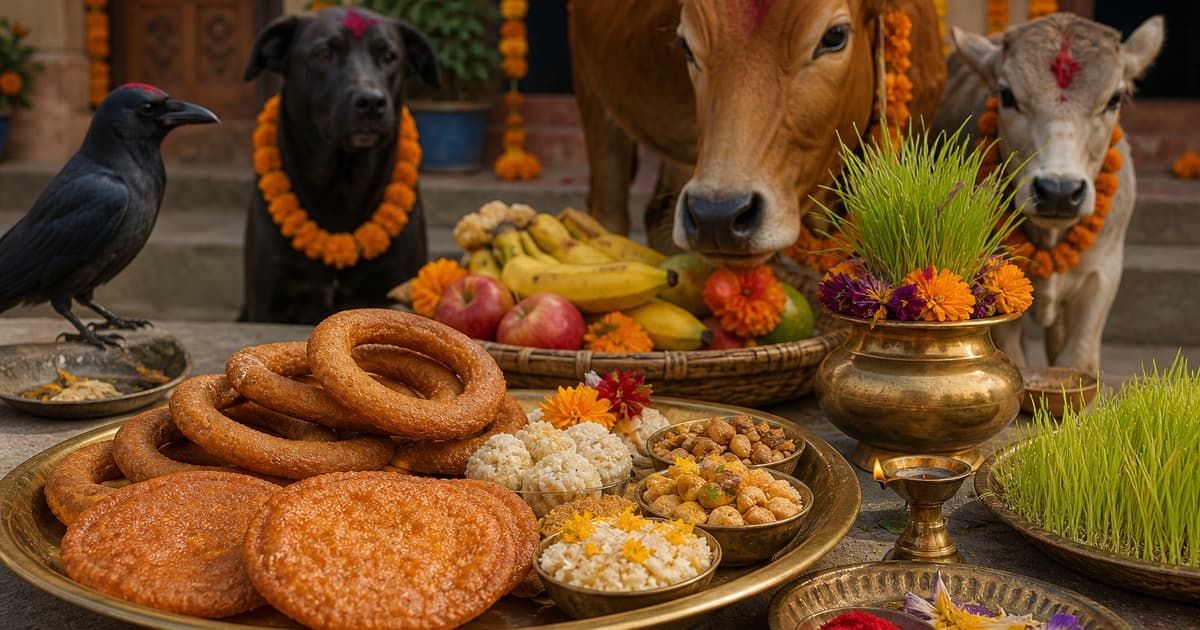
Tihar, Nepal's five-day festival of lights, animals, and sibling bonds, unfolds across late Kartik (October–November) with a rhythm distinct from its Indian Diwali cousin. Each day honors a different relationship: crows on Kaag Tihar, dogs garlanded with marigold on Kukur Tihar, cows on Gai Tihar, and oxen alongside Newari Mha Puja on Day 4. Sel roti — ring-shaped, sweet, rice-flour bread fried golden — is the signature Tihar food, commonly served across all five days and especially central to the Bhai Tika feast on Day 5, when sisters apply the seven-colored Saptarangi tika to their brothers' foreheads. Anarasa, sesame-studded rice-flour pastries, and milk-based sweets like khuwa and pheni often accompany the festive thali, while Newari households may prepare yomari, steamed dumplings filled with chaku jaggery, as part of their distinct Swanti observance. Throughout the festival, Deusi-Bhailo singing groups move house to house, receiving sel roti, sweets, and coins — a Nepali tradition with no direct Diwali parallel.
Signature Dishes
Sel roti
Anarasa
Various sweets and snacks
Brother-sister ritual foods
Cow worship offerings
Regional Variations
Nepal (general Hindu)
Full 5-day Yamapanchak arc: Kaag Tihar, Kukur Tihar, Gai Tihar + Laxmi Puja, Goru Tihar + Govardhan Puja, Bhai Tika with Saptarangi Tika.
Newar community (Kathmandu Valley)
Observed as Swanti — 4-day Newari arc including Mha Puja (self-worship) on Day 4 and Nepal Sambat (Newari New Year); Yomari with chaku filling is signature.
Nepali Terai / southern plains
Closer visual overlap with Indian Diwali Lakshmi Puja on Day 3 evening; diyo lighting and rangoli emphasis stronger; Bhai Tika still primary Day 5.
Nepali hill / mid-mountain regions
Sel roti preparation is especially central; Deusi-Bhailo house-to-house singing traditions strongly observed by youth groups.
Nepali diaspora (US, UK, Australia, Gulf, India, Japan, South Korea, Hong Kong)
Community Tihar gatherings; Bhai Tika ceremonies sometimes adapted for siblings separated by distance; sel roti remains diasporic anchor dish.
Observance Practices
Day 1 Kaag Tihar — offering rice and sweets to crows on rooftops and doorsteps as Yama's messengers
Nepal
Day 2 Kukur Tihar — garlanding dogs with marigold (Sayapatri), applying red tika, and feeding them meat, milk, eggs, and sweets
Nepal
Day 3 morning Gai Tihar — garlanding cows, applying tika, and offering sweet morsels as Lakshmi's vahana
Nepal
Day 3 evening Laxmi Puja — cleaning homes, lighting diyo oil lamps, drawing rangoli/mandala at doorways, offering fruits/sweets/money to Lakshmi
Nepal
Day 4 Goru Tihar — worship of oxen as farming partners
Nepal
Day 4 Govardhan Puja — small cow-dung mound worshiped, associated with Krishna lifting Govardhan hill
Nepal
Day 4 Mha Puja — self/soul worship ritual
Newar community
Day 4 Nepal Sambat — Newari New Year observance
Newar community
Day 5 Bhai Tika — sisters apply Saptarangi (seven-colored) Tika to brothers' foreheads with blessings; brothers offer Dakshina (money) and protection vow
Nepal
Day 5 Bhai Tika festive thali — sel roti, anarsa, sweets, fruits, savories, often khasi ko masu (goat curry)
Nepal
Deusi-Bhailo — youth groups (boys sing Deusi, girls sing Bhailo) go house-to-house through the 5 days receiving sweets and money
Nepal
Preparation and sharing of sel roti — ring-shaped sweet rice-flour deep-fried bread eaten across all 5 days
Nepal
Preparation of Yomari (steamed rice-flour dumpling with chaku filling)
Newar community
Diaspora community Tihar gatherings with adapted Bhai Tika ceremonies
Nepali diaspora
Regions
Cuisines
Related Recipes
Gulab Jamun (गुलाब जामुन) — Indian Rose-Scented Milk Dumplings in Cardamom Syrup
commonly served·Bhai-Tika sweet tradition adjacent
Gajar Ka Halwa (गाजर का हलवा) — Indian Grated Carrot Pudding with Cardamom
commonly served·Bhai-Tika sweet adjacent
Bhel Puri (भेल पूरी) — Indian Puffed Rice Chaat with Tangy Chutneys
commonly served·Festival savory adjacent
Halwa-e Aurd-e Sujee (حلوای آرد و سوجی) — Afghan Semolina Halwa with Cardamom
regional variant·Persian-Afghan-adjacent semolina halwa proxy