Nishollo (Нишолло) — Tajik Whipped Egg-White and Syrup Sweet
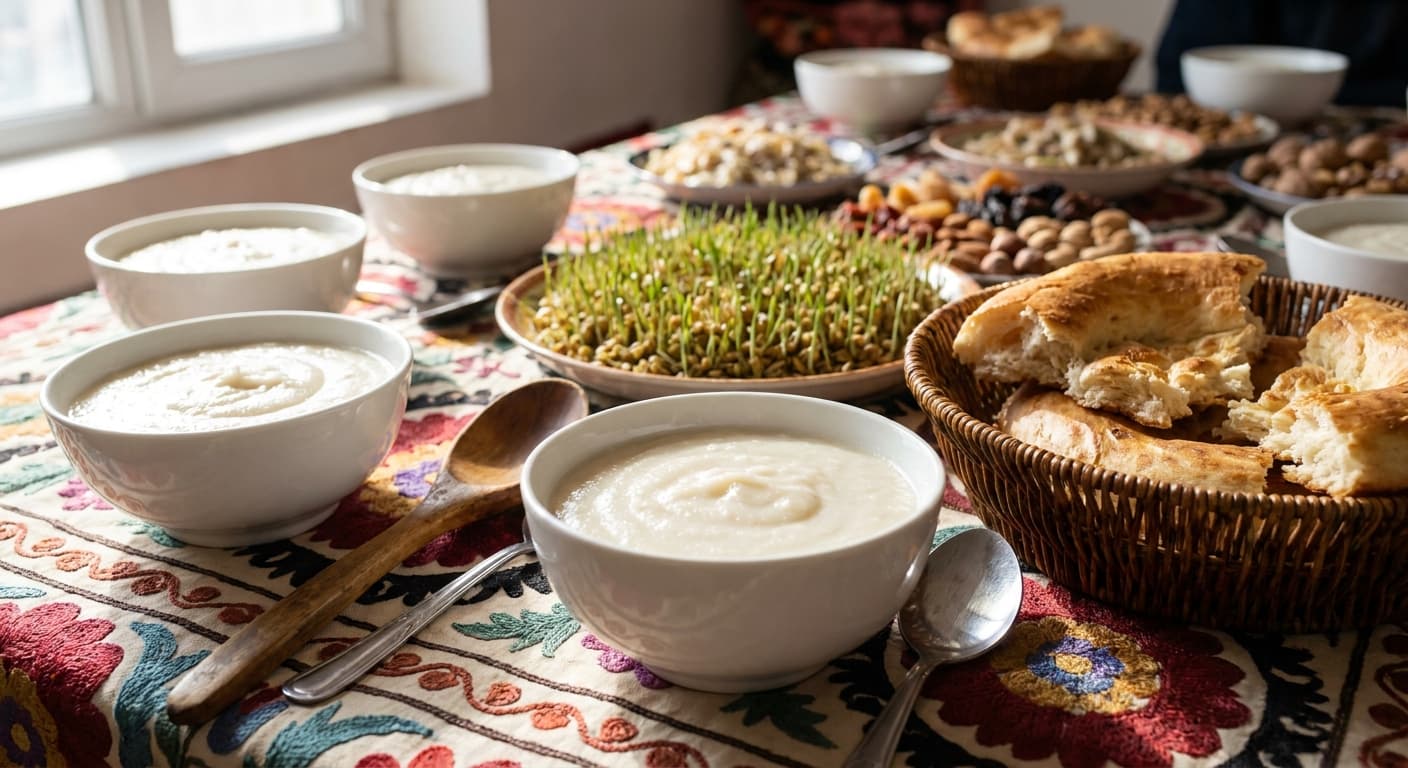
Nishollo is a cloudlike Tajik sweet made by whipping egg whites with sugar syrup and a decoction of culinary bekh, a foaming root. Associated with Navruz and Ramadan tables, it is traditionally enjoyed with non, the region's round bread.
Printable Recipe Card
Servings: 8 · Total: 60 min · Difficulty: hard
Ingredients (quick list)
- 5 g food-grade dried bekh root (Also sold as culinary etmak, traditionally from Acanthophyllum species. Buy only root explicitly sold for making nishollo or nishalda; do not use ornamental soapwort, unidentified roots, or soap-making supplies.)
- 250 ml water
- 350 g granulated sugar
- 5 ml lemon juice (Strained to remove pulp.)
- 2 pasteurized large egg whites (60 g total; use pasteurized whites labeled as suitable for whipping.)
Steps (summary)
- Check that the bekh is a food-grade culinary product intended for nishollo or nishalda, and follow any supplier-specific prepar…
- Put the bekh and 250 ml water in a small saucepan and bring to a boil. Cover partially and simmer gently for 20 minutes, then s…
- Measure the strained decoction and return it to the saucepan if its volume exceeds 75 ml. Simmer until 75 ml remains, then tran…
- Combine the sugar, 125 ml water, and lemon juice in a clean saucepan. Heat gently, stirring until the sugar dissolves, then bri…
- When the syrup reaches 110°C, start whisking the pasteurized egg whites at medium speed until foamy. Add the cooled bekh decoct…
- At 118°C, immediately remove the syrup from the heat and reduce the mixer to medium-low speed. Pour the hot syrup into the foam…
+ 2 more steps in the full instructions section below.
Cultural Background
Nishollo belongs to a shared Central Asian confectionery tradition and appears on Tajik Navruz and Ramadan tables. Glenn Randall Mack and Asele Surina provide regional food-culture context; their work is not cited as the source of this precise formula.
Equipment
💡 Tips
- Use a small saucepan for the syrup so the thermometer probe can sit in the liquid without touching the pan's base.
- Culinary bekh varies in strength and preparation requirements. Use only a product intended for this dessert, and prioritize its labeled culinary directions over a generic root-decoction method.
- Pasteurized egg whites are important because adding hot syrup does not reliably pasteurize every part of the foam.
⚠️ Common Mistakes
❌ Using unidentified roots or nonculinary soapwort products.
✅ Fix: Obtain food-grade bekh or etmak explicitly intended for this confection. If it is unavailable, postpone the traditional recipe rather than improvise with botanical substitutes.
❌ The syrup crystallizes during boiling.
✅ Fix: Dissolve the sugar fully before boiling and stop stirring once it boils. Keep utensils carrying dry sugar crystals out of the syrup.
❌ The foam stays thin or collapses.
✅ Fix: Use grease-free equipment and whipping-compatible pasteurized whites. Measure the decoction carefully and cook the syrup to 118°C rather than judging its concentration by appearance.
❌ Hot syrup scatters around the bowl or forms hard threads on the whisk.
✅ Fix: Lower the mixer speed while pouring. Direct a thin stream down the bowl's interior, away from the whisk wires.
🧊 How to Store
Refrigerate promptly in a covered container at 4°C or below and consume within 24 hours for the best texture. Do not leave at room temperature for more than 2 hours. Do not reheat or freeze; prolonged storage encourages weeping and loss of volume.
📅 Make Ahead
Prepare and strain the bekh decoction up to 24 hours ahead, then refrigerate it in a covered container. Bring the measured 75 ml portion below 30°C before whipping, and make the finished sweet on the day of serving.
🍽️ Pairs Well With
- Non
- unsweetened green tea
- unsweetened black tea
Regional Variations
- In neighboring Uzbekistan, closely related versions are commonly called nisholda or nishalda and likewise combine sugar syrup, egg whites, and a foaming root preparation.
- Tajik household and confectioner versions differ in sweetness and foam density. Bekh strength and the amount of whipping account for much of this variation.
Ingredients
- 5 gfood-grade dried bekh root (Also sold as culinary etmak, traditionally from Acanthophyllum species. Buy only root explicitly sold for making nishollo or nishalda; do not use ornamental soapwort, unidentified roots, or soap-making supplies.)
- 250 mlwater
- 350 ggranulated sugar
- 5 mllemon juice (Strained to remove pulp.)
- 2pasteurized large egg whites (60 g total; use pasteurized whites labeled as suitable for whipping.)
🔄 Substitutions
- pasteurized large egg whites→ 60 g pasteurized carton egg whites suitable for whipping
- food-grade dried bekh root→ food-grade prepared etmak extract intended for nishollo
Instructions
- 1
Check that the bekh is a food-grade culinary product intended for nishollo or nishalda, and follow any supplier-specific preparation requirements. Clean and thoroughly degrease the mixer bowl and whisk, since fat prevents the egg whites from building a stable foam.
- 2
Put the bekh and 250 ml water in a small saucepan and bring to a boil. Cover partially and simmer gently for 20 minutes, then strain through a fine sieve lined with a clean cloth, discarding the root.
- 3
Measure the strained decoction and return it to the saucepan if its volume exceeds 75 ml. Simmer until 75 ml remains, then transfer it to a clean bowl and cool to below 30°C; keep the saucepan partially covered during the initial simmer to avoid reducing it below this volume.
- 4
Combine the sugar, 125 ml water, and lemon juice in a clean saucepan. Heat gently, stirring until the sugar dissolves, then bring to a boil and stop stirring; cook until a sugar thermometer reads 118°C.
- 5
When the syrup reaches 110°C, start whisking the pasteurized egg whites at medium speed until foamy. Add the cooled bekh decoction in three 25 ml additions, whisking between additions, then increase the speed and continue until the mixture forms a substantial white foam.
- 6
At 118°C, immediately remove the syrup from the heat and reduce the mixer to medium-low speed. Pour the hot syrup into the foam in a thin, steady stream down the inside of the bowl, keeping it away from the moving whisk to prevent splashing.
- 7
Increase the mixer to medium-high speed and whip for 8–12 minutes, until the mixture is glossy, thick, and cooled to approximately room temperature. It should hold soft, billowing mounds rather than become dry or crumbly; this thermometer-controlled hot-syrup method adapts the traditional sweet for a home kitchen.
- 8
Divide the nishollo among eight small bowls and serve freshly whipped, or refrigerate promptly until serving. Offer non separately for the traditional bread-and-sweet pairing; bread is not included in the nutrition calculation.
🪪 Recipe Passport
Cultural Background
Nishollo belongs to a shared Central Asian confectionery tradition and appears on Tajik Navruz and Ramadan tables. Glenn Randall Mack and Asele Surina provide regional food-culture context; their work is not cited as the source of this precise formula.
Regional Variations
Researched from multiple sources and validated by the Zaffaron editorial team. Every recipe is tested for accuracy, measurements, and cultural authenticity.
📚 Sources & Cultural References
- Glenn Randall Mack and Asele Surina — Food Culture in Russia and Central Asia — (2005)
Sources cited by the Zaffaron editorial team during recipe research. Cultural and culinary references supporting authenticity claims.
Nutrition per serving
Pairs well with
If you enjoyed this recipe, here are a few related Zaffaron recipes to try next.
Does your family make this differently?
Every family has their own version. Maybe your grandmother adds a secret ingredient, or your aunt has a completely different technique. Preserve your family's version — with their name on it, forever.
You Might Also Like
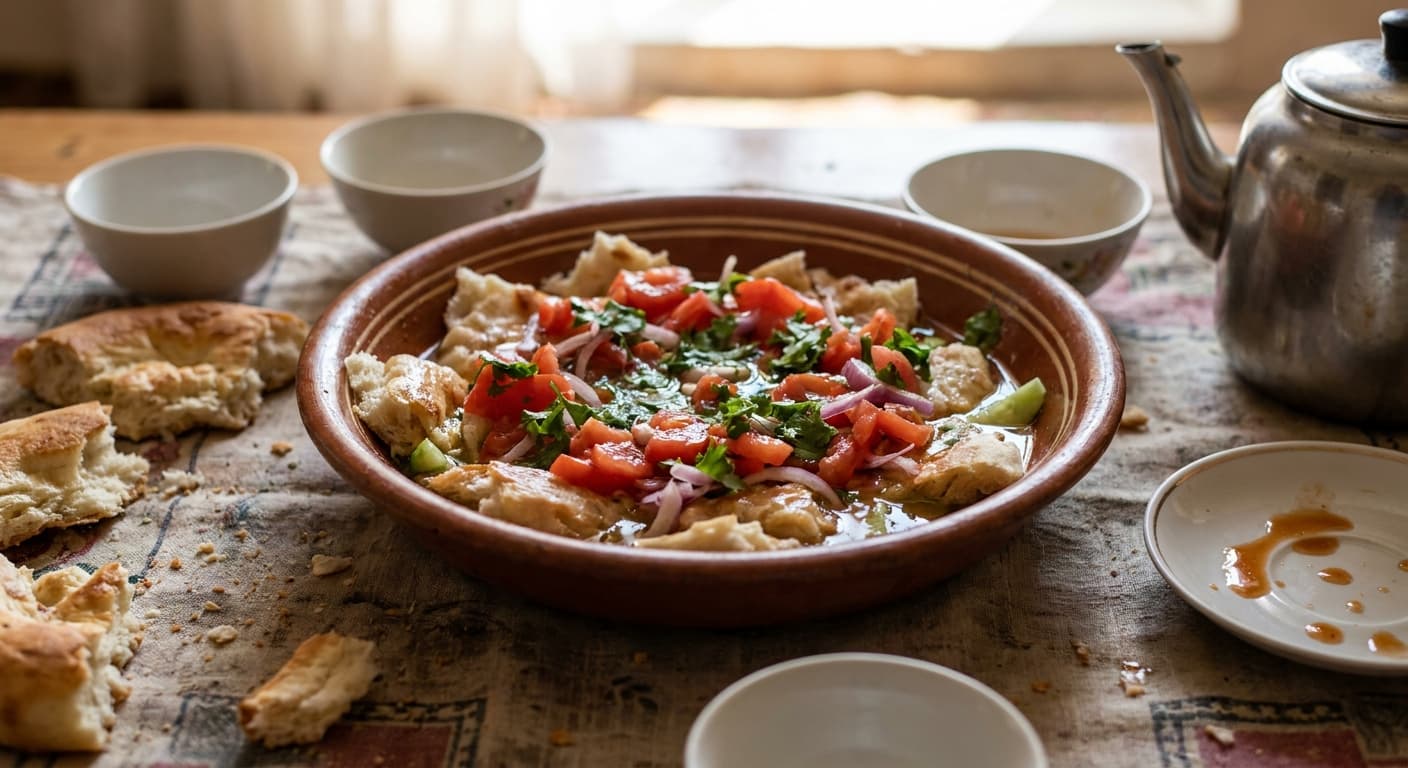
Shakarob (Шакароб) — Tajik Tomato-Onion Bread Salad
Tajik · Salads · 25 min
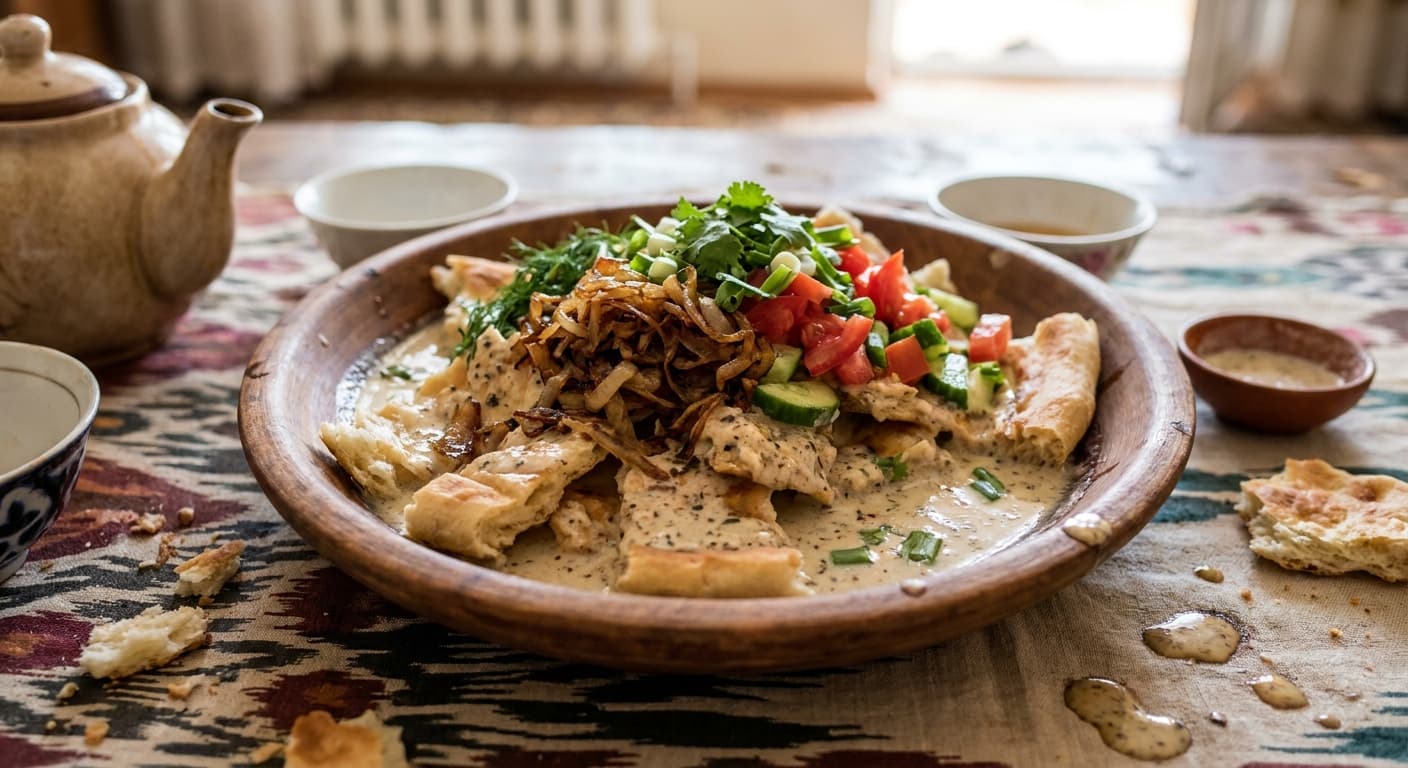
Tajik Qurutob (Қурутоб) — Tangy Bread Salad with Qurut and Fried Onions
Tajik · Main Courses · 40 min
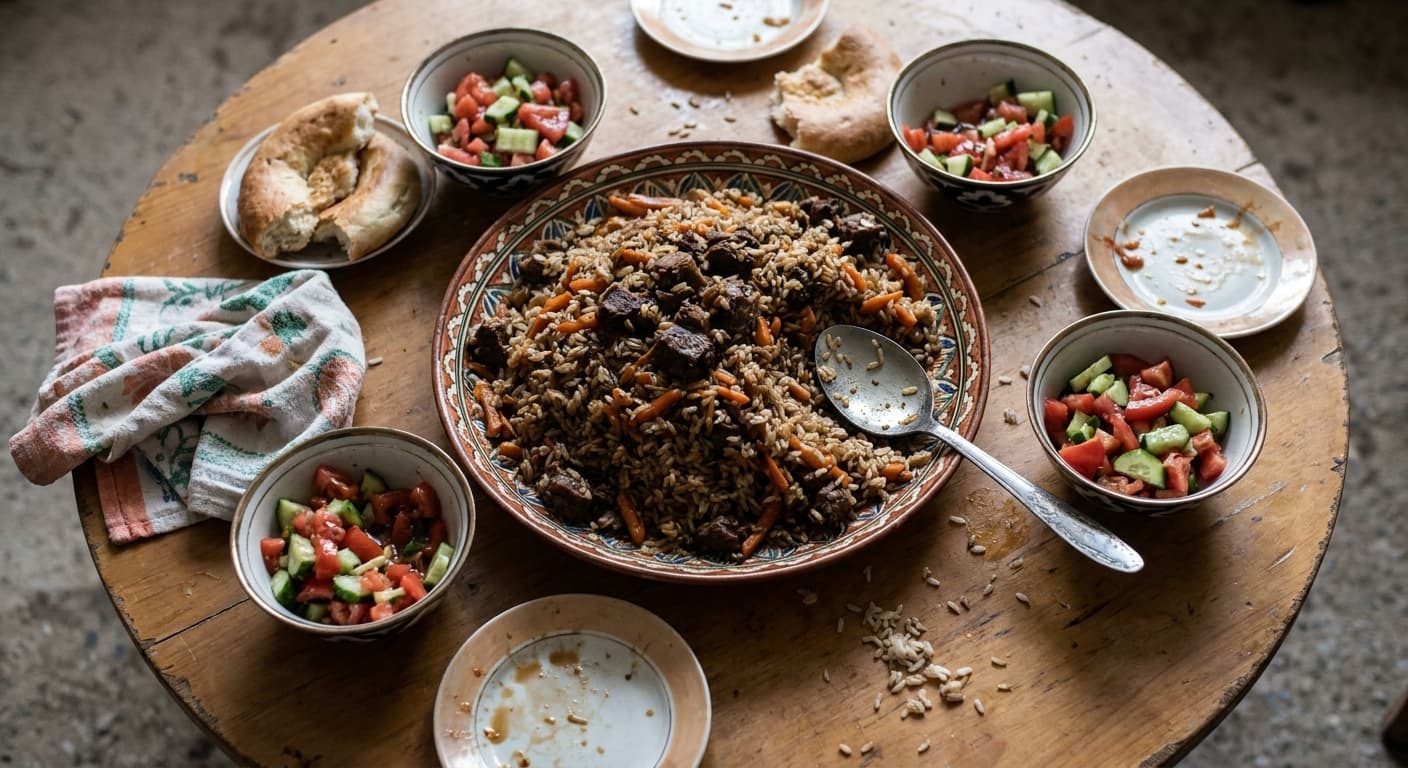
Oshi Siyoh (Оши сиёҳ) — Bukhara-Style Dark Pilaf
Tajik · Rice Dishes · 125 min
Lithuanian Tree Cake (Šakotis) — Spit-Baked Celebration Cake
Lithuanian · Desserts · 230 min
Prekmurje Layer Cake (Prekmurska gibanica) — Slovenian Festival Layer Pastry
Slovenian · Desserts · 185 min
Murgh-e Qorma (مرغ قورمه) — Afghan Chicken in Onion-Tomato Gravy
Afghan · Stews · 95 min
Uzbek Dimlama (Dimlama) — Layered Lamb and Vegetable Stew
Uzbek · Stews · 125 min
Bulgarian Banitsa (Баница) — Flaky Sirene-Filled Phyllo Pie
Bulgarian · Breads · 68 min
Reviews
Cooked this recipe?
Tap the stars to rate it — that's all it takes. A few words are welcome but optional.
No ratings yet. Cooked this one? Be the first to rate it — it takes one tap.