Chaharshanbe Suri
چهارشنبهسوری
About Chaharshanbe Suri
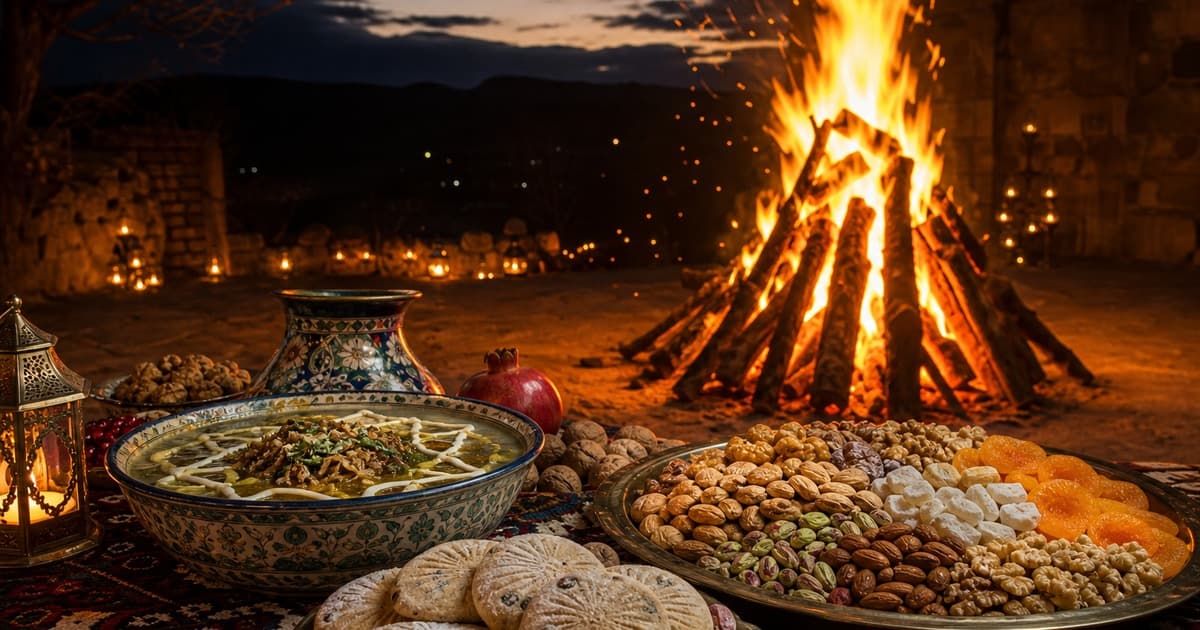
Chaharshanbe Suri, the ancient Persian Festival of Fire, is observed on the last Tuesday evening before Nowruz, when families and neighbors gather in streets and courtyards to leap over small bonfires while chanting 'Zardi-ye-man az to, sorkhi-ye-to az man' — passing winter's paleness to the flames and drawing back warmth and vigor. The table around the fire is traditionally anchored by Ash Reshteh, a thick Persian herb-and-noodle soup laced with kashk, commonly served to symbolize the tangled threads of fate being unraveled before the new year. Bowls of Ajil-e Moshkel-gosha — the 'problem-solving' mix of seven nuts and dried fruits including pistachios, chickpeas, mulberries, and figs — are passed hand to hand as wishes are made. Kolucheh, fragrant spiced cookies, often appear alongside saffron-scented sweets for the children who go qashogh-zani, banging spoons door-to-door for treats. In Kurdish regions the fire-jumping ritual is shared with local helva and sweets, while Afghan and Tajik Persian-speaking households layer in their own pulao and bolani traditions. Rooted in pre-Islamic Zoroastrian fire reverence, Chaharshanbe Suri remains distinct from Nowruz itself — a luminous threshold night of purification, laughter, and shared sweetness.
Signature Dishes
Ash Reshteh
آش رشته
Ajil-e Moshkel-gosha
آجیل مشکلگشا
Kolucheh
کلوچه
Regional Variations
Iran (Persian heartland)
Primary observance: street bonfire-jumping with Zardi-ye-man chant, qashogh-zani door-knocking, ajeel platter, ash-e reshteh, sholeh zard; some modern use of firecrackers.
Kurdish regions (Iranian, Iraqi, Turkish Kurdistan)
Şewa Çarşemê fire-jumping shared with Persian core; Kurdish helva and regional sweets accompany; some link to Pîr-i Şalyar traditions in certain Kurdish areas.
Afghanistan (Tajik-Afghan, Hazara, Persian-speaking)
Similar fire-jumping practiced in Persian-speaking communities; family meals often feature qabili pulao and bolani adjacent to the festival evening.
Azerbaijan
Pre-Novruz bonfire traditions (Akhir Chershenbe / last-Tuesday fire) overlap thematically; jumping over fires with purification intent is widely observed.
Tajikistan / Central Asian Persian-speaking
Persian-rooted fire observance with similar pre-Nowruz purification motif; localized food traditions vary by community.
Iranian diaspora (US, UK, Germany, Canada, Australia, France)
Community-park or backyard bonfires where fire codes permit; cultural association gatherings preserve qashogh-zani and ajeel traditions.
Observance Practices
Evening bonfire preparation in streets, parks, or communal areas (traditionally seven small fires)
Fire-jumping with chant 'Zardi-ye-man az to, sorkhi-ye-to az man' for purification and renewal
Qashogh-zani (spoon-banging door-to-door for sweets) by children and youth
Iran (and Persian-speaking communities)
Sharing ajeel (mixed nuts and dried fruits platter) with family and guests
Family meals featuring ash-e reshteh, ash-e anar, sholeh zard, reshteh polo, kashk-o-bademjan
Iran
Fal-e Kuza-shekani (water-pot fortune-telling) and related divination customs
Iran
Kurdish helva and regional sweets shared around fire gatherings
Kurdish regions
Qabili pulao and bolani served at family meals adjacent to fire observance
Afghanistan
Community-association or park bonfire events adapted to local fire regulations
Iranian diaspora
Modern firecracker use (contested; pre-modern observance was pure bonfire ritual)
Iran (contemporary urban)
Regions
Cuisines
Related Recipes
Ash Reshteh (آش رشته) — Persian Herb, Bean, and Noodle Soup
signature·Iran
Ash Reshteh (آش رشته) — Persian Herb and Noodle Soup
signature·Iran
Pomegranate Herb Soup (آش انار)
commonly served·Iran
Ash-e Sholeh Ghalamkar (آش شله قلمکار)
commonly served·Iran
Haft Mewa (هفت میوه) — Afghan Seven-Fruit Nowruz Compote
regional variant·Afghanistan