Hinamatsuri / Girls’ Day
ひな祭り
About Hinamatsuri / Girls’ Day
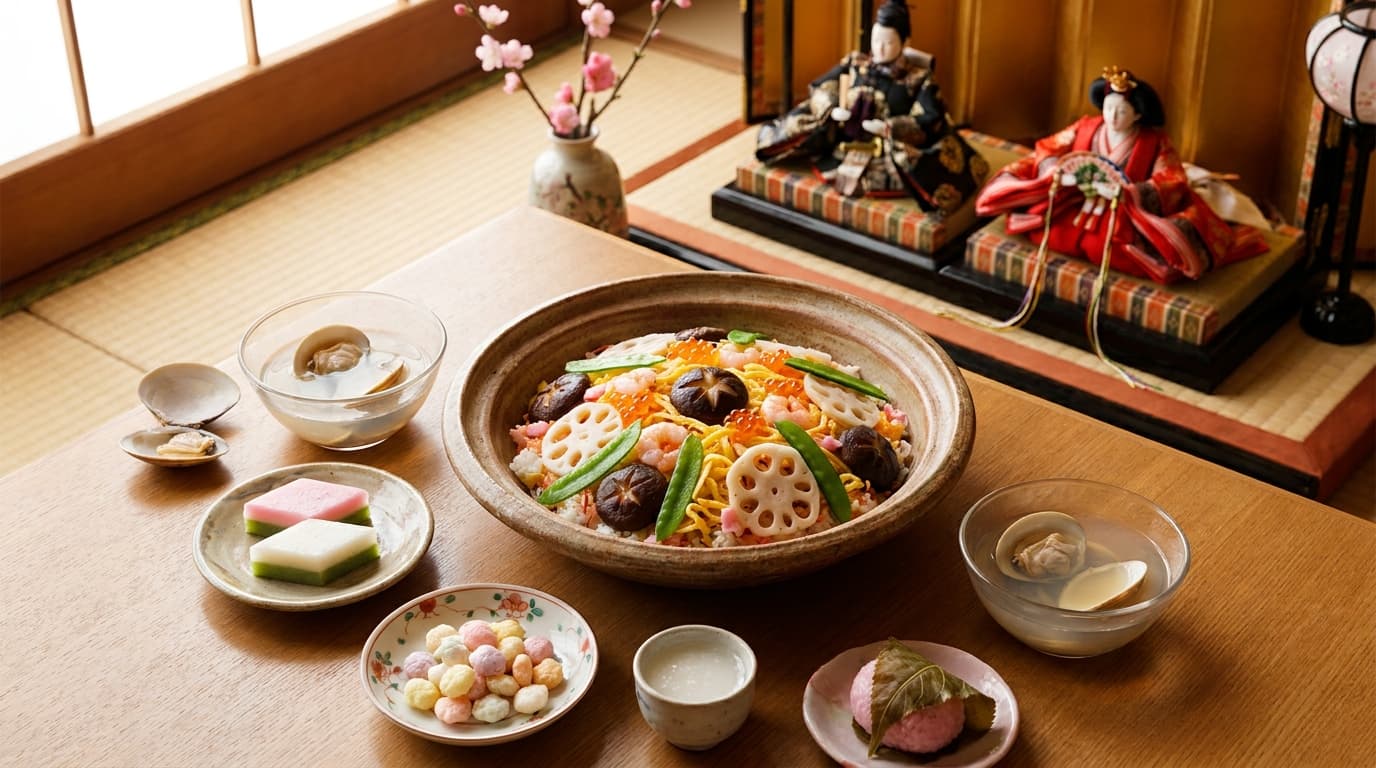
Hinamatsuri (雛祭り), or Girls' Day, falls on March 3rd as a household festival praying for daughters' health, growth, and marital fortune. The centerpiece is the hinadan (雛壇), a tiered display of ornamental dolls representing the Heian-period imperial court, set up weeks in advance and traditionally taken down promptly after March 3rd lest the household's daughters marry late. The Girls' Day table is defined by symbolic spring-color foods. Chirashi-zushi layers vinegared rice with shiitake, lotus root, snow peas, sweet egg ribbons, and pink shrimp — a celebratory bowl distinct from everyday sushi. Hina-arare are pastel rice crackers in pink, white, green, and yellow. Hishimochi is a diamond-shaped tri-color mochi (pink/white/green) symbolizing peach blossoms, snow, and new grass. When sakura mochi appears at Hinamatsuri it is a Girls'-Day household sweet — distinct from the picnic sakura mochi of Hanami. Clear hamaguri clam soup uses paired shells as a fidelity symbol.
Signature Dishes
Chirashi sushi
Hina-arare
ひなあられ
Sakura mochi
桜餅
Clam soup
hamaguri osuimono
Shirozake
Regional Variations
Kanto (Tokyo-style)
Male doll on the left when viewed (Showa-era convention); chirashi-zushi often shrimp-forward with shiitake and snow peas.
Kansai (Kyoto-style)
Male doll on the right per traditional Heian court protocol; richer egg-ribbon and conger-eel layering in chirashi-zushi.
Tohoku
Heirloom hinadan passed across generations; saké-cured fish and sweet rice variants; later display take-down timing tolerated due to cold spring.
Kyushu
Regional clam varieties beyond hamaguri; satsuma-imo sweet potato sometimes incorporated into festival sweets.
Diaspora Japanese-American (Hawaii/California)
Simplified household displays; chirashi-zushi remains the table anchor; hinadan often single-tier compact.
Observance Practices
Hinadan tiered doll display: set up weeks in advance and taken down promptly after March 3rd to avoid late-marriage superstition for the household's daughters.
Chirashi-zushi family meal: celebratory scattered-sushi bowl distinct from everyday sushi-ya fare, made at home with spring-color toppings.
Hina-arare and hishimochi: symbolic-color sweets (peach blossom/snow/new grass = pink/white/green; four-seasons rice crackers).
Hamaguri clam soup tradition: paired clam shells symbolize fidelity (each shell only fits its original pair); served clear with minimal seasoning.
Sakura mochi at Hinamatsuri (G6 disambiguation): read as a Girls'-Day-specific sweet within the Girls'-Festival food cluster (alongside shirozake 白酒 and amazake 甘酒 sweet-rice-toast cups served at the family table), distinct from Hanami's picnic sakura mochi later in spring — same confection, different ritual context.