Japanese Obon
お盆
About Japanese Obon
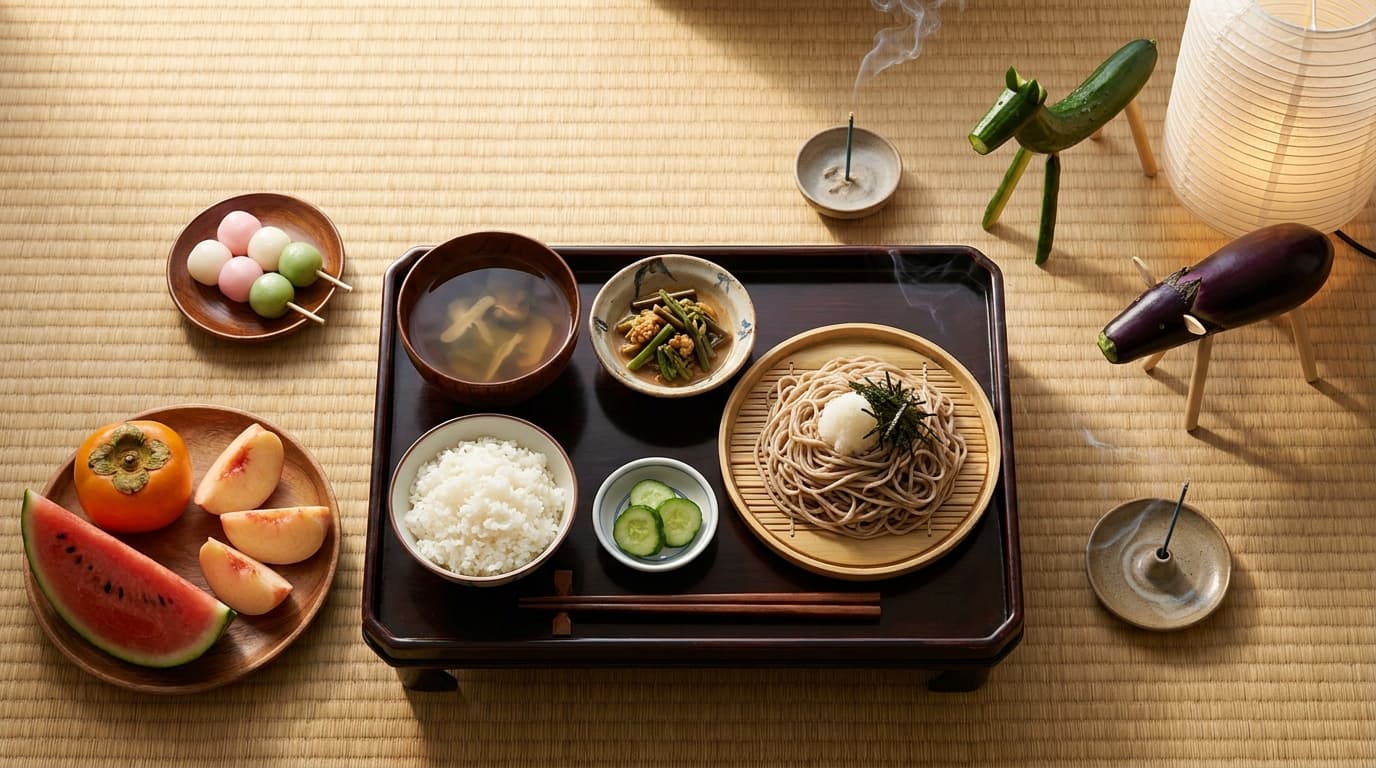
Obon (お盆) is a Buddhist observance held in mid-July or mid-August (depending on regional lunar/solar tradition) honoring ancestral spirits believed to return to the living world during the festival days. Households light welcome fires (mukaebi) on the first evening to guide spirits home, and farewell fires (okuribi) on the last to send them back; bon-odori folk dances mark the public-square nights. The food framework centers on shojin ryori (精進料理), the vegetarian Buddhist temple cuisine prepared for altars and family meals during obon — dashi made from kombu and shiitake instead of bonito, deep flavor from miso, soy, and seasonal vegetables, no meat or fish, no garlic or onion. Obon dango (sweet rice dumplings) and seasonal summer fruits accompany altar offerings. The festival's most visible foodway is the cucumber-and-eggplant spirit horses (shōryō uma), carved with toothpick legs — cucumber for swift arrival, eggplant for slow return — though these are ritual objects, not eaten.
Signature Dishes
Obon dango
Vegetarian Buddhist cuisine
shojin ryori
Cucumber and eggplant spirit horses
Sweets for ancestral altars
Regional summer foods
Regional Variations
Kanto (Tokyo)
Observed in mid-July (shichigatsu-bon) per modern solar-calendar shift; bon-odori city-wide; smaller-scale family altars.
Kansai and most of Japan
Observed in mid-August (hachigatsu-bon) per lunar-calendar legacy; one of Japan's three largest annual travel periods as families return home.
Okinawa
Distinct Ryukyuan observance (kyū-bon) tied to lunar calendar; ancestral altar food includes pork-based dishes alongside shojin elements (regional Buddhist syncretism).
Tohoku
Heirloom altar setups; locally-foraged mountain vegetables in shojin preparations; mukaebi welcome-fire traditions particularly elaborate.
Diaspora communities (Hawaii/California Japanese-American Buddhist temples)
Bon-odori dance preserved as community festival; shojin ryori served at temple-level rather than household.
Observance Practices
Welcome fires (mukaebi) + farewell fires (okuribi): the Kyoto Daimonji mountain bonfires (August 16th) are the most famous okuribi tradition.
Shojin ryori altar offerings: kombu-shiitake dashi-based vegetarian Buddhist cuisine prepared for ancestor altars and shared by the family.
Spirit-horse carvings (shōryō uma): cucumber for swift arrival, eggplant for slow return — ritual objects placed at the altar, NOT consumed.
Bon-odori folk dances: Awa Odori (Tokushima), Gujo Odori (Gifu), Nishimonai Bon Odori (Akita) are signature regional dance forms.
Family-gathering travel (hachigatsu-bon): mid-August Obon is one of Japan's three largest annual travel periods (alongside New Year/Oshogatsu and Golden Week).
Kansai and most of Japan