Kazakh Beshbarmak (Бешбармақ) — Boiled Meat and Noodles in Onion Broth
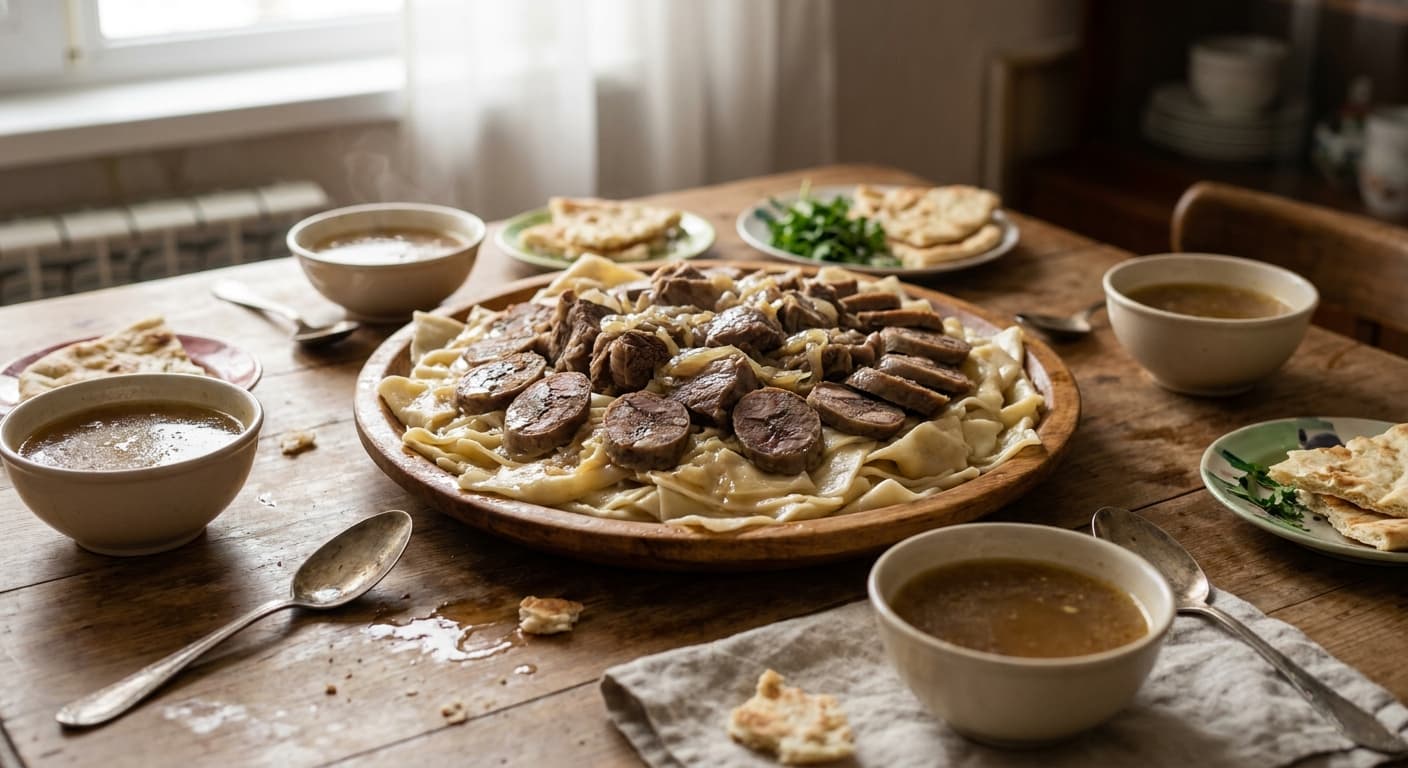
Beshbarmak is Kazakhstan’s emblematic feast dish: tender boiled meat laid over wide hand-cut noodles and finished with onion-rich broth. Its name means “five fingers,” recalling the traditional way of eating it by hand at communal gatherings.
Printable Recipe Card
Servings: 6 · Total: 210 min · Difficulty: medium
Ingredients (quick list)
- 900 g lamb shoulder on the bone
- 600 g beef brisket
- 300 g kazy horse sausage (use halal-certified kazy if required)
- 3.5 l cold water
- 1 large onion (peeled and halved)
- 2 leaf bay leaves
- 2 tsp black peppercorns
- 18 g fine sea salt
- 500 g all-purpose flour
- 2 eggs
- 160 ml warm water
- 40 g plain flour
+ 4 more in the full ingredients section below.
Steps (summary)
- Place the lamb shoulder and beef brisket in a large stockpot and cover with 3.5 l cold water. Bring slowly to a bare simmer ove…
- Add the halved onion, bay leaves, peppercorns, and 18 g salt to the pot. Reduce the heat to low, cover loosely, and simmer for…
- Prick the kazy sausage in 3 places with a skewer and add it to the simmering pot. Cook for 35 to 45 minutes more, until the lam…
- While the meat cooks, make the noodle dough by mixing 500 g flour and 6 g salt in a wide bowl. Beat in the eggs and 160 ml warm…
- Wrap the dough and rest it at room temperature for 30 minutes. This rest hydrates the flour fully and makes it possible to roll…
- Divide the dough into 3 portions and roll each portion on a floured surface to about 2 mm thick. Cut the sheets into rough diam…
+ 5 more steps in the full instructions section below.
Cultural Background
Beshbarmak is central to Kazakh hospitality and is often served on large shared platters at family feasts, weddings, and Nauryz celebrations. The arrangement of meat traditionally reflects respect for guests and elders.
Equipment
💡 Tips
- Keep the broth below a boil after skimming; hard boiling makes the stock cloudy and can toughen the meat.
- Roll the noodles very thin because they swell noticeably when cooked in broth.
- If using salty commercial kazy, reduce the broth salt by 4 g and correct the seasoning only after straining.
⚠️ Common Mistakes
❌ Boiling the broth too aggressively
✅ Fix: Keep the pot at a low simmer after skimming so the broth remains clear and the meat cooks gently.
❌ Stacking fresh noodles without enough flour
✅ Fix: Dust the cut noodles lightly but evenly and keep them spread out until cooking.
❌ Serving the dish dry
✅ Fix: Spoon onion broth over the platter and serve extra hot sorpa on the side.
🧊 How to Store
Store meat, noodles, onion sauce, and broth in separate airtight containers for up to 3 days in the refrigerator. Reheat noodles gently in hot broth, then warm the sliced meat in the same broth so it stays moist.
📅 Make Ahead
The broth and cooked meat can be made 1 day ahead and refrigerated separately. Prepare the noodle dough up to 6 hours ahead, but roll and cut it shortly before cooking for the best texture.
🍽️ Pairs Well With
- Hot sorpa broth
- sliced raw radish
- cucumber-tomato salad
- fermented mare’s milk or ayran.
Regional Variations
- In western Kazakhstan, horse meat and kazy are especially prized and may be the dominant meats.
- Some northern households prepare the dish with beef and lamb only when kazy is unavailable.
- Kyrgyz and neighboring Central Asian versions may use similar boiled meat and noodles but differ in cutting style and serving customs.
Ingredients
- 900 glamb shoulder on the bone
- 600 gbeef brisket
- 300 gkazy horse sausage (use halal-certified kazy if required)
- 3.5 lcold water
- 1large onion (peeled and halved)
- 2 leafbay leaves
- 2 tspblack peppercorns
- 18 gfine sea salt
- 500 gall-purpose flour
- 2eggs
- 160 mlwarm water
- 40 gplain flour
- 2large onions (thinly sliced into half-moons)
- 500 mlhot strained meat broth
- 1.5 tspfreshly ground black pepper
- 0.5 bunchflat-leaf parsley (finely chopped)
🔄 Substitutions
- kazy horse sausage→ halal beef sausage or extra beef brisket
- lamb shoulder on the bone→ mutton shoulder on the bone
- all-purpose flour→ bread flour
Instructions
- 1
Place the lamb shoulder and beef brisket in a large stockpot and cover with 3.5 l cold water. Bring slowly to a bare simmer over medium heat, skimming the gray foam carefully for 15 minutes so the broth stays clear.
- 2
Add the halved onion, bay leaves, peppercorns, and 18 g salt to the pot. Reduce the heat to low, cover loosely, and simmer for 2 hours, keeping the liquid at a gentle tremble rather than a rolling boil.
- 3
Prick the kazy sausage in 3 places with a skewer and add it to the simmering pot. Cook for 35 to 45 minutes more, until the lamb and beef are very tender and the kazy is heated through without splitting.
- 4
While the meat cooks, make the noodle dough by mixing 500 g flour and 6 g salt in a wide bowl. Beat in the eggs and 160 ml warm water, then knead for 8 to 10 minutes until the dough is firm, smooth, and no longer sticky.
- 5
Wrap the dough and rest it at room temperature for 30 minutes. This rest hydrates the flour fully and makes it possible to roll the dough thinly without tearing.
- 6
Divide the dough into 3 portions and roll each portion on a floured surface to about 2 mm thick. Cut the sheets into rough diamonds or rectangles about 8 cm wide, dust them with the 40 g plain flour, and lay them in a single layer while the broth finishes.
- 7
Lift the cooked meats and kazy from the broth and keep them warm under foil or a lid. Strain the broth through a fine sieve, discard the boiled onion and spices, and reserve at least 2 l of clear broth for cooking noodles and serving.
- 8
For the onion sauce, put the sliced onions, 500 ml hot strained broth, 3 g salt, and 1.5 tsp black pepper in a saucepan. Simmer for 8 to 10 minutes, until the onions soften but still hold their shape and the broth becomes sweet and aromatic.
- 9
Bring 1.5 l of the remaining strained broth to a lively simmer in a wide pot. Cook the noodle diamonds in batches for 3 to 4 minutes, stirring gently so they do not stick, then lift them out with a slotted spoon.
- 10
Slice the beef, lamb, and kazy across the grain into generous pieces. Arrange the hot noodles on a large platter, lay the sliced meats on top, spoon over the onion sauce, and sprinkle with parsley.
- 11
Serve the extra hot broth in small bowls alongside the platter, as is customary for sorpa. Encourage diners to moisten their portion with more broth, because beshbarmak should be hearty and juicy rather than dry.
🪪 Recipe Passport
Cultural Background
Beshbarmak is central to Kazakh hospitality and is often served on large shared platters at family feasts, weddings, and Nauryz celebrations. The arrangement of meat traditionally reflects respect for guests and elders.
Regional Variations
Researched from multiple sources and validated by the Zaffaron editorial team. Every recipe is tested for accuracy, measurements, and cultural authenticity.
📚 Sources & Cultural References
- Kazakh Tourism National Company — Kazakhstan.travel culinary culture materials
- Oxford University Press — The Oxford Companion to Food — (2014)
Sources cited by the Zaffaron editorial team during recipe research. Cultural and culinary references supporting authenticity claims.
Nutrition per serving
Pairs well with
If you enjoyed this recipe, here are a few related Zaffaron recipes to try next.
Does your family make this differently?
Every family has their own version. Maybe your grandmother adds a secret ingredient, or your aunt has a completely different technique. Preserve your family's version — with their name on it, forever.
You Might Also Like
Nauryz Kozhe (Наурыз көже) — Seven-Ingredient Kazakh Spring Soup
Kazakh · Soups · 175 min
Shelpek (Шелпек) — Kazakh Fried Flatbread
Kazakh · Breads · 63 min
Kazy (Қазы) — Kazakh Horsemeat Rib Sausage
Kazakh · Appetizers · 240 min
Orromo (Оромо) — Kyrgyz Steamed Rolled Dumpling with Lamb and Pumpkin
Kyrgyz · Main Courses · 105 min
Swedish Smörgåsbord (Smörgåsbord) — Classic Buffet with Gravlax, Sill, and Köttbullar
Swedish · Main Courses · 115 min
Oshi Siyoh (Оши сиёҳ) — Bukhara-Style Dark Pilaf
Tajik · Rice Dishes · 125 min
Uzbek Dimlama (Dimlama) — Layered Lamb and Vegetable Stew
Uzbek · Stews · 125 min
Beef Pho (Phở Bò) — Vietnamese Beef Noodle Soup
Vietnamese · Soups · 405 min
Reviews
Cooked this recipe?
Tap the stars to rate it — that's all it takes. A few words are welcome but optional.
No ratings yet. Cooked this one? Be the first to rate it — it takes one tap.