Kazy (Қазы) — Kazakh Horsemeat Rib Sausage
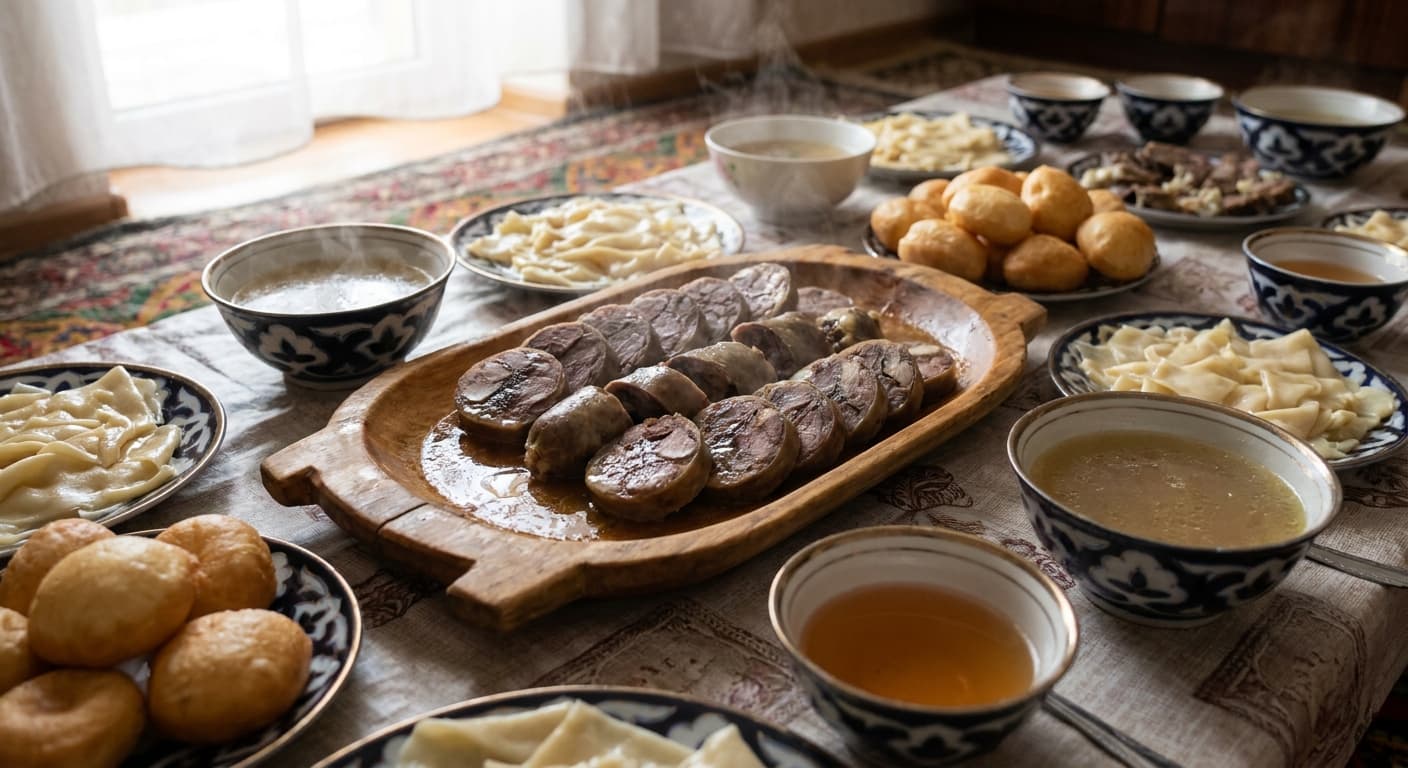
Kazy is a treasured Kazakh sausage made from fatty horse rib meat stuffed into natural casing, then cured briefly and gently boiled. It is sliced for a dastarkhan, served with beshbarmak, sorpa, and festive breads such as baursak.
Printable Recipe Card
Servings: 10 · Total: 240 min · Difficulty: hard
Ingredients (quick list)
- 1.2 kg horse rib meat (cut in long strips about 3 cm wide, with connective tissue removed)
- 300 g horse rib fat or zhal (cut in long strips to run through the center of the sausage)
- 1.5 m cleaned horse intestine casing or beef middle casing
- 2 l cold water
- 30 ml white vinegar
- 32 g kosher salt
- 4 clove garlic (finely grated)
- 8 g black pepper (freshly ground)
- 4 g cumin seed (lightly crushed)
- 50 ml ice water
- 3 l water
- 1 yellow onion (peeled and halved)
+ 2 more in the full ingredients section below.
Steps (summary)
- Rinse the casing under cold running water, then soak it in 2 l cold water mixed with 30 ml white vinegar for 30 minutes. Flush…
- Lay the horse rib meat and horse rib fat or zhal on a chilled board and cut them into long, even strips that will fit neatly in…
- Combine the salt, garlic, ground black pepper, crushed cumin seed, and 50 ml ice water in a large bowl. Rub this seasoning thor…
- Tie one end of the casing securely with kitchen twine, then slide in alternating strips of seasoned horse meat and fat without…
- Prick the casing in 8 to 10 spots with a sterilized needle to prevent bursting during cooking. Rest the filled kazy at room tem…
- Put 3 l water, the onion, bay leaves, peppercorns, and 10 g salt in a wide pot and bring it just to a bare simmer. Lower in the…
+ 2 more steps in the full instructions section below.
Cultural Background
As Glenn R. Mack and Asele Surina note in their work on Central Asian food culture, horsemeat is central to Kazakh hospitality. Kazy is a prestige food for the dastarkhan, especially with beshbarmak and sorpa.
Equipment
💡 Tips
- Use fatty rib meat rather than lean leg meat, because kazy should be rich, marbled, and succulent when sliced.
- Do not boil the sausage hard; vigorous bubbling can split the casing and toughen the horsemeat.
- A rest of at least 12 hours after seasoning gives the most authentic cured flavor without requiring a long drying process.
⚠️ Common Mistakes
❌ Packing the casing too tightly.
✅ Fix: Leave a little give in the casing and prick small air pockets before cooking so the sausage can expand without bursting.
❌ Cooking at a rolling boil.
✅ Fix: Hold the liquid at a bare simmer, ideally 80 to 85°C, for tender meat and an intact casing.
❌ Using lean horsemeat only.
✅ Fix: Include rib fat or zhal so the slices have the characteristic rich texture of kazy.
🧊 How to Store
Refrigerate cooked kazy tightly wrapped for up to 4 days. Reheat slices gently in hot sorpa or steam for 3 to 5 minutes; avoid pan-frying over high heat because the casing and fat can toughen.
📅 Make Ahead
Season and stuff the kazy 1 day ahead, then keep it covered in the refrigerator. Cooked kazy also slices cleanly after chilling and can be reheated gently in sorpa.
🍽️ Pairs Well With
- Beshbarmak
- sorpa
- baursak
- sliced onion
- boiled potatoes
- kymyz.
Regional Variations
- Some Kazakh households dry or smoke kazy after salting, especially in colder regions and during winter slaughter season.
- Garlic may be reduced or omitted in very simple family versions that rely mainly on salt, black pepper, and the flavor of horse rib meat.
- For large feasts, kazy is often boiled in the same pot as meat for beshbarmak, enriching the sorpa served with the meal.
Ingredients
- 1.2 kghorse rib meat (cut in long strips about 3 cm wide, with connective tissue removed)
- 300 ghorse rib fat or zhal (cut in long strips to run through the center of the sausage)
- 1.5 mcleaned horse intestine casing or beef middle casing
- 2 lcold water
- 30 mlwhite vinegar
- 32 gkosher salt
- 4 clovegarlic (finely grated)
- 8 gblack pepper (freshly ground)
- 4 gcumin seed (lightly crushed)
- 50 mlice water
- 3 lwater
- 1yellow onion (peeled and halved)
- 2 leafbay leaves
- 6 gblack peppercorns
🔄 Substitutions
- cleaned horse intestine casing→ beef middle casing
- horse rib fat or zhal→ beef back fat
- horse rib meat→ fatty beef short-rib meat
Instructions
- 1
Rinse the casing under cold running water, then soak it in 2 l cold water mixed with 30 ml white vinegar for 30 minutes. Flush the inside of the casing with cold water to check for tears and to remove any remaining salt or odor.
- 2
Lay the horse rib meat and horse rib fat or zhal on a chilled board and cut them into long, even strips that will fit neatly into the casing. Keeping the pieces long is important because traditional kazy shows a visible line of meat and fat when sliced.
- 3
Combine the salt, garlic, ground black pepper, crushed cumin seed, and 50 ml ice water in a large bowl. Rub this seasoning thoroughly over the meat and fat, then cover and refrigerate for 12 to 24 hours so the salt penetrates evenly.
- 4
Tie one end of the casing securely with kitchen twine, then slide in alternating strips of seasoned horse meat and fat without packing them so tightly that the casing strains. Press out trapped air as you go, then tie the second end to form one long sausage or two shorter links.
- 5
Prick the casing in 8 to 10 spots with a sterilized needle to prevent bursting during cooking. Rest the filled kazy at room temperature for 20 minutes while you prepare the poaching liquid.
- 6
Put 3 l water, the onion, bay leaves, peppercorns, and 10 g salt in a wide pot and bring it just to a bare simmer. Lower in the kazy, keep the liquid at 80 to 85°C, and cook gently for about 2 hours until the center reaches 74°C.
- 7
Lift the sausage from the pot and let it cool for 20 minutes before slicing, which helps the juices settle. Strain the poaching liquid and serve it as a light sorpa alongside the sliced kazy if desired.
- 8
Slice the kazy on a slight diagonal into 5 mm rounds and arrange it warm or room temperature on a platter. For a Kazakh feast, serve it with beshbarmak noodles, onion from the broth, sorpa, and baursak on the side.
🪪 Recipe Passport
Cultural Background
As Glenn R. Mack and Asele Surina note in their work on Central Asian food culture, horsemeat is central to Kazakh hospitality. Kazy is a prestige food for the dastarkhan, especially with beshbarmak and sorpa.
Regional Variations
Researched from multiple sources and validated by the Zaffaron editorial team. Every recipe is tested for accuracy, measurements, and cultural authenticity.
📚 Sources & Cultural References
- Glenn R. Mack and Asele Surina — Food Culture in Russia and Central Asia — (2005)
- Alan Davidson — The Oxford Companion to Food — (2014)
Sources cited by the Zaffaron editorial team during recipe research. Cultural and culinary references supporting authenticity claims.
Nutrition per serving
Pairs well with
If you enjoyed this recipe, here are a few related Zaffaron recipes to try next.
Does your family make this differently?
Every family has their own version. Maybe your grandmother adds a secret ingredient, or your aunt has a completely different technique. Preserve your family's version — with their name on it, forever.
You Might Also Like
Shelpek (Шелпек) — Kazakh Fried Flatbread
Kazakh · Breads · 63 min
Kazakh Beshbarmak (Бешбармақ) — Boiled Meat and Noodles in Onion Broth
Kazakh · Main Courses · 210 min
Nauryz Kozhe (Наурыз көже) — Seven-Ingredient Kazakh Spring Soup
Kazakh · Soups · 175 min
Huancayo-Style Potatoes (Papa a la Huancaína) — Peruvian Potatoes in Ají Amarillo Cheese Sauce
Peruvian · Appetizers · 45 min
Lumpia Shanghai (Lumpiang Shanghai) — Crispy Filipino Pork Spring Rolls
Filipino · Appetizers · 65 min
Uzbek Shurpa (Шўрпа) — Lamb and Vegetable Soup
Uzbek · Soups · 160 min
Shakarob (Шакароб) — Tajik Tomato-Onion Bread Salad
Tajik · Salads · 25 min
Pone Yay Gyi Curry (ပုန်းရည်ကြီးဟင်း) — Burmese Pork and Fermented Bean Paste
Burmese · Main Courses · 115 min
Reviews
Cooked this recipe?
Tap the stars to rate it — that's all it takes. A few words are welcome but optional.
No ratings yet. Cooked this one? Be the first to rate it — it takes one tap.