Kuku Do Rang (کوکو دو رنگ) — Two-Color Persian Layered Frittata
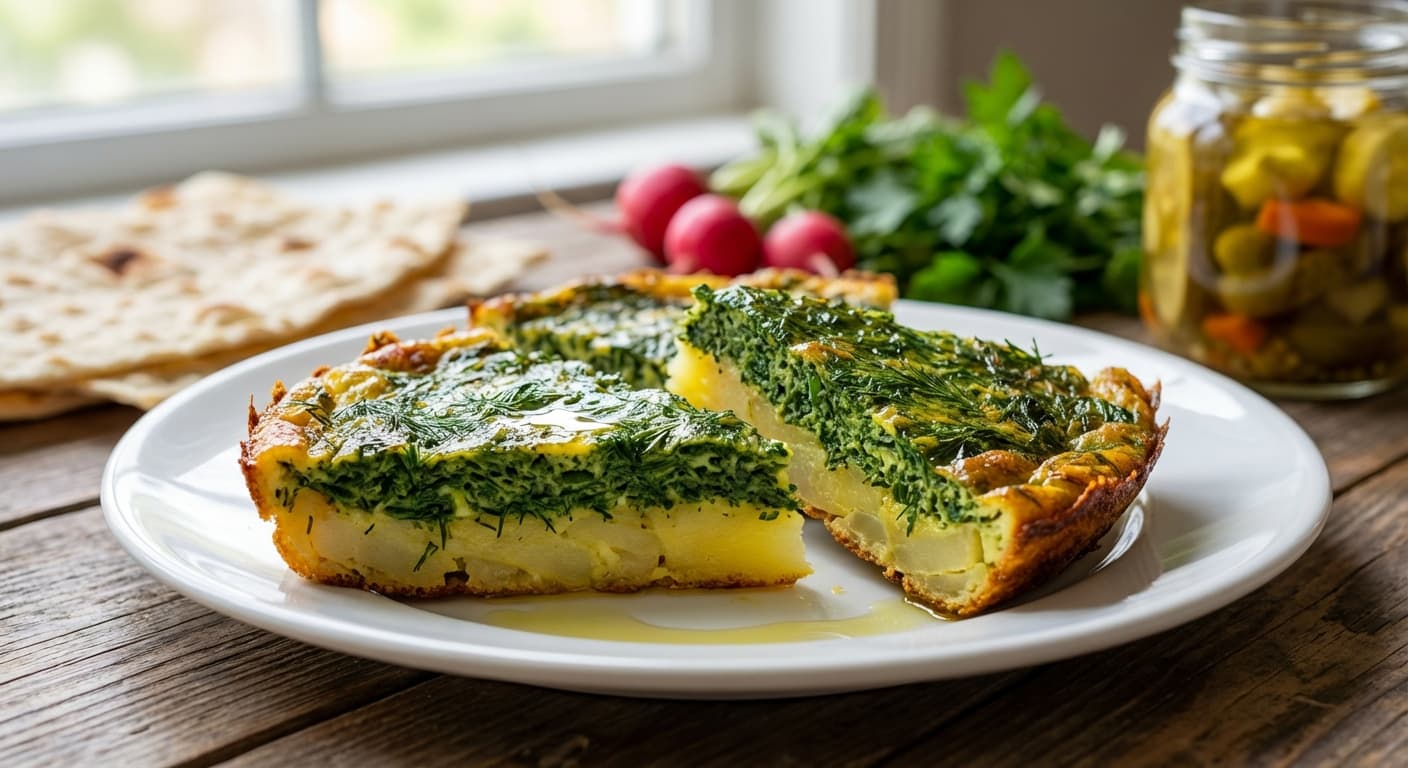
Kuku Do Rang layers potato kuku with herb kuku for a striking two-tone slice. It’s a celebratory Iranian technique that turns everyday eggs, herbs, and potatoes into a refined, shareable dish.
Printable Recipe Card
Servings: 6 · Total: 55 min · Difficulty: medium
Ingredients (quick list)
- 450 g Russet potatoes, peeled (about 2 medium potatoes)
- 3 Eggs (large)
- 10 g Wheat flour (about 1 tbsp, helps bind)
- 3 g Salt (about 1/2 tsp)
- 1 g Black pepper (about 1/2 tsp)
- 60 g Fresh parsley, finely chopped (packed, stems removed)
- 30 g Fresh cilantro, finely chopped (packed, tender stems ok)
- 20 g Fresh dill, finely chopped (packed)
- 15 g Fresh chives, finely chopped (or Persian tareh if available)
- 45 ml Vegetable oil (about 3 tbsp, divided)
Steps (summary)
- Prepare two separate bowls so the layers stay distinct and clean-looking. Set a 24 cm nonstick skillet (with a lid) over medium…
- Make the potato layer: grate the potatoes on the large holes of a box grater into a bowl. Squeeze the grated potatoes firmly in…
- Add 3 eggs, 10 g flour, 3 g salt, and 1 g black pepper to the potatoes. Mix thoroughly for 45 seconds until the egg coats every…
- Make the herb layer: finely chop parsley, cilantro, dill, and chives so the pieces are small and even. Add the herbs to a secon…
- Heat the skillet over medium heat and add 30 ml vegetable oil, swirling to coat the bottom and lower sides. When the oil shimme…
- Cover with a lid and cook the potato layer for 8 minutes over medium-low heat so it sets without burning. The edges should look…
+ 4 more steps in the full instructions section below.
Cultural Background
Kuku is a cornerstone of Iranian home cooking, served from everyday breakfasts to festive spreads. Kuku Do Rang elevates the tradition with a layered presentation that highlights Iran’s love of herbs and clever, beautiful plating.
Equipment
💡 Tips
- Squeezing the grated potatoes for a full 60 seconds prevents a watery potato layer and helps it brown evenly.
- Keep the herb layer on low heat under a lid so it sets gently and stays green rather than turning dull and dry.
- Resting for 10 minutes before slicing is essential for sharp, two-color layers that do not slide apart.
⚠️ Common Mistakes
❌ Skipping the potato squeeze, leading to a soggy, fragile bottom layer.
✅ Fix: Squeeze grated potatoes in a towel for 60 seconds, then mix immediately so the starch helps bind.
❌ Cooking the herb layer on high heat, which browns the greens and dries the top.
✅ Fix: Use low heat with a lid for gentle setting, then only briefly crisp after flipping.
❌ Spreading the herb mixture too aggressively and mixing the layers.
✅ Fix: Spoon the herb batter in small mounds, then gently level with the back of a spoon without pressing down.
🧊 How to Store
Cool completely, then refrigerate slices in an airtight container for up to 3 days. Reheat in a covered skillet over low heat for 6–8 minutes or in a 180°C oven for 8–10 minutes to warm through without drying.
📅 Make Ahead
Chop the herbs up to 24 hours ahead and refrigerate them in a sealed container lined with a paper towel. You can also grate and squeeze the potatoes 2 hours ahead, then keep them covered in the fridge and mix with eggs just before cooking.
🍽️ Pairs Well With
- Lavash
- sabzi khordan
- torshi
- yogurt with cucumber
- tomato and radish salad
Regional Variations
- Some Tehran-style versions add 30 g finely chopped walnuts to the herb layer for a richer, more festive slice.
- In northern Iran, cooks may increase dill and chives for a sharper herbal profile and serve it with more torshi.
- A lighter modern variation bakes the layered kuku in a 20 cm pan at 190°C for 18–22 minutes, then broils for 1–2 minutes for color.
Ingredients
- 450 gRusset potatoes, peeled (about 2 medium potatoes)
- 3Eggs (large)
- 10 gWheat flour (about 1 tbsp, helps bind)
- 3 gSalt (about 1/2 tsp)
- 1 gBlack pepper (about 1/2 tsp)
- 60 gFresh parsley, finely chopped (packed, stems removed)
- 30 gFresh cilantro, finely chopped (packed, tender stems ok)
- 20 gFresh dill, finely chopped (packed)
- 15 gFresh chives, finely chopped (or Persian tareh if available)
- 45 mlVegetable oil (about 3 tbsp, divided)
🔄 Substitutions
- Fresh dill→ Fresh mint
- Vegetable oil→ Grapeseed oil
- Wheat flour→ Rice flour
Instructions
- 1
Prepare two separate bowls so the layers stay distinct and clean-looking. Set a 24 cm nonstick skillet (with a lid) over medium heat for 2 minutes, then turn it off while you mix.
- 2
Make the potato layer: grate the potatoes on the large holes of a box grater into a bowl. Squeeze the grated potatoes firmly in a clean towel for 60 seconds to remove excess moisture, then return them to the bowl.
- 3
Add 3 eggs, 10 g flour, 3 g salt, and 1 g black pepper to the potatoes. Mix thoroughly for 45 seconds until the egg coats every strand and the mixture looks glossy and cohesive.
- 4
Make the herb layer: finely chop parsley, cilantro, dill, and chives so the pieces are small and even. Add the herbs to a second bowl, then add 4 eggs, 10 g flour, 3 g salt, and 1 g black pepper and stir for 45 seconds until the herbs are evenly suspended.
- 5
Heat the skillet over medium heat and add 30 ml vegetable oil, swirling to coat the bottom and lower sides. When the oil shimmers (about 60–90 seconds), spread the potato mixture into an even layer and press it gently with a spatula to level it.
- 6
Cover with a lid and cook the potato layer for 8 minutes over medium-low heat so it sets without burning. The edges should look dry and lightly golden, and the center should feel springy when pressed gently.
- 7
Drizzle 15 ml vegetable oil around the edges of the pan to help release and crisp the sides. Carefully spoon the herb mixture over the potato layer, then spread it evenly to the edges without digging into the bottom layer.
- 8
Cover again and cook for 10 minutes over low heat so the herb layer sets while staying bright. Check once halfway through and rotate the pan if your burner has hot spots, keeping the heat low to avoid browning the greens too much.
- 9
Flip to finish: loosen the edges all around with a thin spatula, then slide the kuku onto a flat plate. Invert it back into the skillet so the herb side is now down, then cook uncovered for 5–6 minutes over medium-low heat to fully set the center and lightly crisp the surface.
- 10
Transfer to a cutting board and rest for 10 minutes so clean layers form when sliced. Cut into 6 wedges or rectangles and serve warm or at room temperature for the best contrast of colors and textures.
🪪 Recipe Passport
Cultural Background
Kuku is a cornerstone of Iranian home cooking, served from everyday breakfasts to festive spreads. Kuku Do Rang elevates the tradition with a layered presentation that highlights Iran’s love of herbs and clever, beautiful plating.
Regional Variations
Researched from multiple sources and validated by the Zaffaron editorial team. Every recipe is tested for accuracy, measurements, and cultural authenticity.
Nutrition per serving
Pairs well with
If you enjoyed this recipe, here are a few related Zaffaron recipes to try next.
Does your family make this differently?
Every family has their own version. Maybe your grandmother adds a secret ingredient, or your aunt has a completely different technique. Preserve your family's version — with their name on it, forever.
You Might Also Like
Borani Kadu (بورانی کدو) — Saffron-Infused Zucchini and Yogurt Dip
Persian · Appetizers · 40 min
Mixed Vegetable Rice (برنج با مخلوط سبزیجات) — Persian-Style Aromatic Pilaf
Persian · Rice Dishes · 75 min
Katteh Tond (کته تند) — Spicy Caspian-Style One-Pot Chicken Rice
Persian · Rice Dishes · 85 min
Orromo (Оромо) — Kyrgyz Steamed Rolled Dumpling with Lamb and Pumpkin
Kyrgyz · Main Courses · 105 min
Swedish Smörgåsbord (Smörgåsbord) — Classic Buffet with Gravlax, Sill, and Köttbullar
Swedish · Main Courses · 115 min
Izmir Kofte (İzmir Köfte) — Oven-Baked Meatballs with Tomato Sauce and Potatoes
Turkish · Main Courses · 70 min
Sac Kavurma (Saç Kavurma) — Thin-Sliced Turkish Meat Sautéed with Onions
Turkish · Main Courses · 38 min
Khoresh Tareh Farangi (خورش تره فرنگی) — Persian Leek and Lamb Stew
Persian · Stews · 130 min
Reviews
Cooked this recipe?
Tap the stars to rate it — that's all it takes. A few words are welcome but optional.
No ratings yet. Cooked this one? Be the first to rate it — it takes one tap.