Zagorje Mlinci (Zagorski mlinci) — Thin Baked Flatbread for Roast Juices
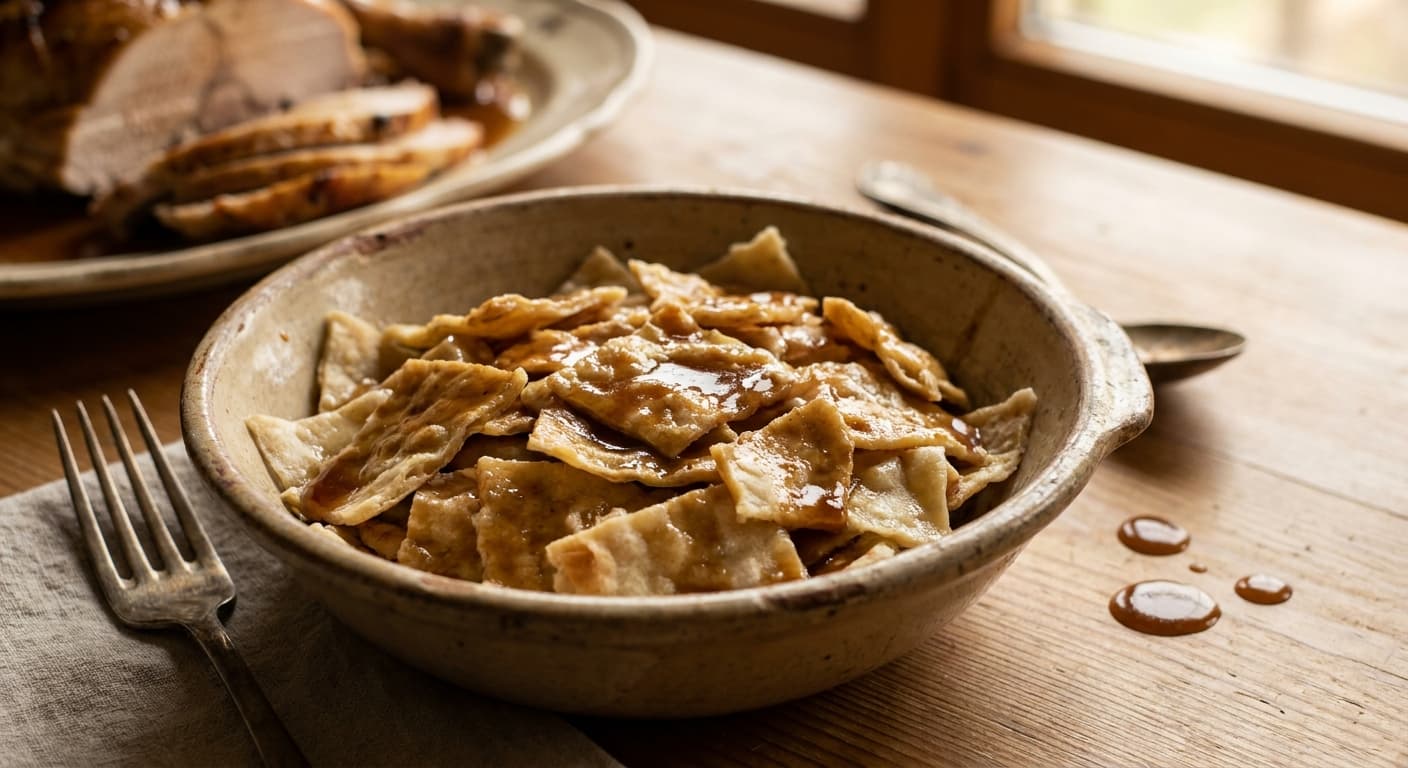
Zagorje mlinci are thin, dry-baked Croatian flatbreads from northern Croatia, most famously served with roast turkey or chicken. They share the Zagorje table with štrukli, but their purpose is different: soaking up rich pan juices.
Printable Recipe Card
Servings: 6 · Total: 73 min · Difficulty: medium
Ingredients (quick list)
- 500 g plain all-purpose flour (Croatian type 550 flour is ideal)
- 8 g fine sea salt
- 1 eggs
- 240 ml lukewarm water
- 1.5 l water
- 240 ml hot roast turkey or chicken pan juices (strained from the roasting pan, with some fat included)
Steps (summary)
- Combine the flour and 8 g salt in a wide mixing bowl, then make a well in the center. Add the egg and 240 ml lukewarm water, mi…
- Turn the dough onto a lightly floured surface and knead for 8 minutes, until smooth, elastic, and no longer sticky. The dough s…
- Cover the dough with an inverted bowl and rest it for 20 minutes at room temperature. This rest relaxes the gluten and makes th…
- Heat the oven to 250°C and place two heavy baking sheets inside to preheat. Divide the dough into 6 equal portions, keeping unu…
- Roll one portion into a very thin oval or rectangle, about 1 mm thick and roughly 30 cm across, using only enough of the 30 g d…
- Lay the rolled dough directly onto a hot baking sheet and bake for 4 to 5 minutes, turning once if needed, until dry, blistered…
+ 3 more steps in the full instructions section below.
Cultural Background
As noted in Croatian food writing by Liz Vidic, dishes such as mlinci express the roast-centered hospitality of northern Croatia. In Zagorje, mlinci sit beside turkey much as štrukli and strukli signal regional identity, distinct from coastal peka traditions.
Equipment
💡 Tips
- Roll the dough thinner than ordinary flatbread; thick mlinci become chewy instead of tender after scalding.
- Bake the sheets until dry and blistered, not evenly browned like crackers, because pale patches absorb pan juices better.
- Scald the broken sheets briefly and drain them immediately; long boiling turns mlinci pasty.
⚠️ Common Mistakes
❌ Rolling the dough too thick
✅ Fix: Roll each portion to about 1 mm thick so the sheets bake dry and soften evenly when scalded.
❌ Boiling the baked mlinci for several minutes
✅ Fix: Simmer for only 45 seconds, then drain immediately to preserve structure.
❌ Using lean stock alone for finishing
✅ Fix: Include fatty roast pan juices or rendered poultry fat, because mlinci are meant to absorb richness from the roast.
🧊 How to Store
Store completely dry baked mlinci sheets in an airtight tin at room temperature for up to 2 weeks. Once scalded and dressed with pan juices, refrigerate leftovers for up to 2 days and reheat covered in a 160°C oven with 30 ml stock.
📅 Make Ahead
Bake and cool the dry mlinci sheets up to 2 weeks ahead, then store airtight. Break, scald, and dress them with hot pan juices only just before serving.
🍽️ Pairs Well With
- Roast turkey
- roast chicken
- green salad with vinegar
- braised red cabbage
- Zagorje štrukli.
Regional Variations
- In Hrvatsko Zagorje, mlinci are most closely associated with roast turkey, especially festive purica s mlincima.
- Some households make a lean dough with only flour, salt, and water, while others add 1 egg for a more supple sheet.
- Families without a wood-fired stove often bake the sheets on very hot oven trays, while older methods use a hot stove plate.
- Modern Croatian menus may serve mlinci alongside roast poultry after starters such as štrukli, while coastal meals more often feature peka or pašticada instead.
Ingredients
- 500 gplain all-purpose flour (Croatian type 550 flour is ideal)
- 8 gfine sea salt
- 1eggs
- 240 mllukewarm water
- 1.5 lwater
- 240 mlhot roast turkey or chicken pan juices (strained from the roasting pan, with some fat included)
🔄 Substitutions
- plain all-purpose flour→ Croatian type 550 wheat flour
- hot roast turkey or chicken pan juices→ 180 ml hot poultry stock mixed with 60 ml rendered chicken fat
- egg→ 45 ml lukewarm water
Instructions
- 1
Combine the flour and 8 g salt in a wide mixing bowl, then make a well in the center. Add the egg and 240 ml lukewarm water, mixing with your fingers or a wooden spoon until a firm, shaggy dough forms.
- 2
Turn the dough onto a lightly floured surface and knead for 8 minutes, until smooth, elastic, and no longer sticky. The dough should be firmer than soft štrukli dough, because mlinci must roll very thin and bake dry rather than pillowy.
- 3
Cover the dough with an inverted bowl and rest it for 20 minutes at room temperature. This rest relaxes the gluten and makes the sheets easier to roll without tearing.
- 4
Heat the oven to 250°C and place two heavy baking sheets inside to preheat. Divide the dough into 6 equal portions, keeping unused portions covered so they do not dry out.
- 5
Roll one portion into a very thin oval or rectangle, about 1 mm thick and roughly 30 cm across, using only enough of the 30 g dusting flour to prevent sticking. Uneven rustic edges are traditional, but the center should be thin enough to blister quickly.
- 6
Lay the rolled dough directly onto a hot baking sheet and bake for 4 to 5 minutes, turning once if needed, until dry, blistered, and lightly browned in patches. Repeat with the remaining dough portions, stacking the baked sheets on a rack so steam can escape.
- 7
Let the baked sheets cool completely until crisp, then break them into irregular pieces about 5 to 8 cm wide. At this stage they should resemble dry flatbread shards, which is why mlinci keep well before being revived with roast juices.
- 8
Bring 1.5 l water and 6 g salt to a full boil in a large pot. Add the broken mlinci, simmer for 45 seconds, then drain immediately so they soften without becoming mushy.
- 9
Transfer the drained mlinci to a warm serving bowl and pour over 240 ml hot roast turkey or chicken pan juices. Toss gently for 1 minute so the sheets absorb the fat and juices, then serve at once beside the roast.
🪪 Recipe Passport
Cultural Background
As noted in Croatian food writing by Liz Vidic, dishes such as mlinci express the roast-centered hospitality of northern Croatia. In Zagorje, mlinci sit beside turkey much as štrukli and strukli signal regional identity, distinct from coastal peka traditions.
Regional Variations
Researched from multiple sources and validated by the Zaffaron editorial team. Every recipe is tested for accuracy, measurements, and cultural authenticity.
📚 Sources & Cultural References
- Liz Vidic — Croatian Cuisine
- Ino Kuvačić — Dalmatia — (2017)
Sources cited by the Zaffaron editorial team during recipe research. Cultural and culinary references supporting authenticity claims.
Nutrition per serving
Pairs well with
If you enjoyed this recipe, here are a few related Zaffaron recipes to try next.
Does your family make this differently?
Every family has their own version. Maybe your grandmother adds a secret ingredient, or your aunt has a completely different technique. Preserve your family's version — with their name on it, forever.
You Might Also Like
Strukli (Štrukli) — Croatian Cheese-Filled Pastry
Croatian · Main Courses · 95 min
Croatian Peka (Peka) — Dalmatian Ember-Baked Lamb and Potatoes
Croatian · Main Courses · 150 min
Brodet (Brodet) — Croatian Adriatic Fish Stew with Tomato and White Wine
Croatian · Stews · 70 min
Dry-Fried Green Beans (干煸四季豆) — Sichuan Wok-Blistered Beans with Pork
Chinese · Side Dishes · 27 min
German Bread Dumplings (Semmelknödel) — Bavarian Bread Dumplings
German · Side Dishes · 50 min
Jókai Bean Soup (Jókai-bableves) — Smoked Pork and Tejföl Bean Soup
Hungarian · Soups · 185 min
Karadjordje's Schnitzel (Карађорђева шницла) — Serbian Kajmak-Filled Cutlet
Serbian · Main Courses · 48 min
Chicken and Andouille Gumbo (English) — Louisiana Roux Stew
American · Stews · 120 min
Reviews
Cooked this recipe?
Tap the stars to rate it — that's all it takes. A few words are welcome but optional.
No ratings yet. Cooked this one? Be the first to rate it — it takes one tap.